IJERPH, Vol. 21, Pages 559: DEXA Body Composition Asymmetry Analysis and Association to Injury Risk and Low Back Pain in University Soccer Players
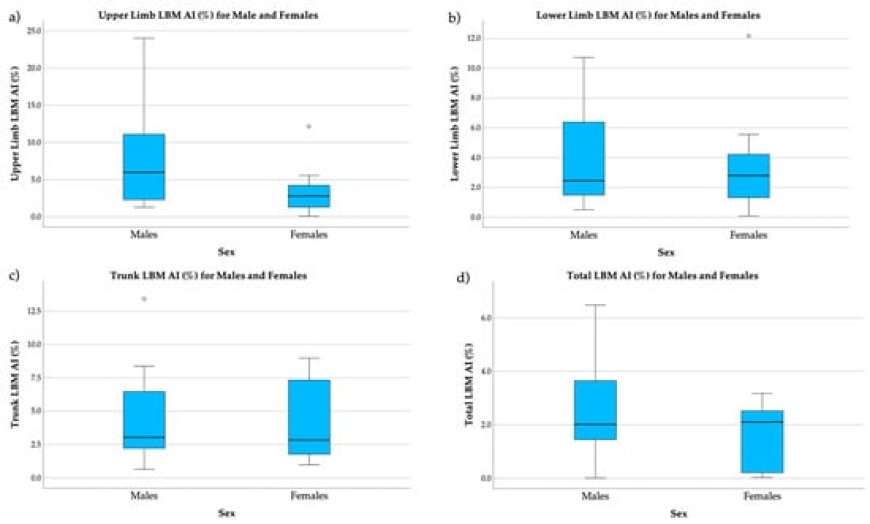
Soccer is a laterally dominant sport owing to the repetitive nature of unilateral kicking. The relationship between functional and body composition asymmetries related to limb dominance in soccer players has yet to be established. When present, asymmetries can increase the risk of injury and low back pain. Our study investigated whether lateral dominance is associated with limb asymmetries in a comprehensive body composition assessment among varsity soccer players. Twenty-seven varsity soccer players (age 20.4 ± 1.7 years old; BMI 22.6 ± 4.6 kg/m2) participated in this study. Body composition was assessed through dual-energy X-ray absorptiometry scans. Results showed low lower limb asymmetry indices in both males (3.82%) and females (3.36%) compared to normal ranges. However, upper limb lean mass exhibited high asymmetry, surpassing thresholds in males (7.3%) and females (4.39%). Significant differences were found in total bone mass among males and total lean body mass among females. Male players exhibited higher asymmetry indices in both arm and trunk mass compared to females. Despite these asymmetries, no significant correlations were found between asymmetry indices and occurrences of lower limb injury or low back pain. The study suggests that while evaluating body composition for injury prevention in soccer shows potential, lateral dominance may be influenced by factors extending beyond sport-specific adaptations.
IJERPH, Vol. 21, Pages 559: DEXA Body Composition Asymmetry Analysis and Association to Injury Risk and Low Back Pain in University Soccer Players
International Journal of Environmental Research and Public Health doi: 10.3390/ijerph21050559
Authors: Nicolas Vaillancourt Chanelle Montpetit Victoria Carile Maryse Fortin
Soccer is a laterally dominant sport owing to the repetitive nature of unilateral kicking. The relationship between functional and body composition asymmetries related to limb dominance in soccer players has yet to be established. When present, asymmetries can increase the risk of injury and low back pain. Our study investigated whether lateral dominance is associated with limb asymmetries in a comprehensive body composition assessment among varsity soccer players. Twenty-seven varsity soccer players (age 20.4 ± 1.7 years old; BMI 22.6 ± 4.6 kg/m2) participated in this study. Body composition was assessed through dual-energy X-ray absorptiometry scans. Results showed low lower limb asymmetry indices in both males (3.82%) and females (3.36%) compared to normal ranges. However, upper limb lean mass exhibited high asymmetry, surpassing thresholds in males (7.3%) and females (4.39%). Significant differences were found in total bone mass among males and total lean body mass among females. Male players exhibited higher asymmetry indices in both arm and trunk mass compared to females. Despite these asymmetries, no significant correlations were found between asymmetry indices and occurrences of lower limb injury or low back pain. The study suggests that while evaluating body composition for injury prevention in soccer shows potential, lateral dominance may be influenced by factors extending beyond sport-specific adaptations.
What's Your Reaction?