Water, Vol. 16, Pages 1183: Life Cycle Assessment as a Decision-Making Tool for Photochemical Treatment of Iprodione Fungicide from Wastewater
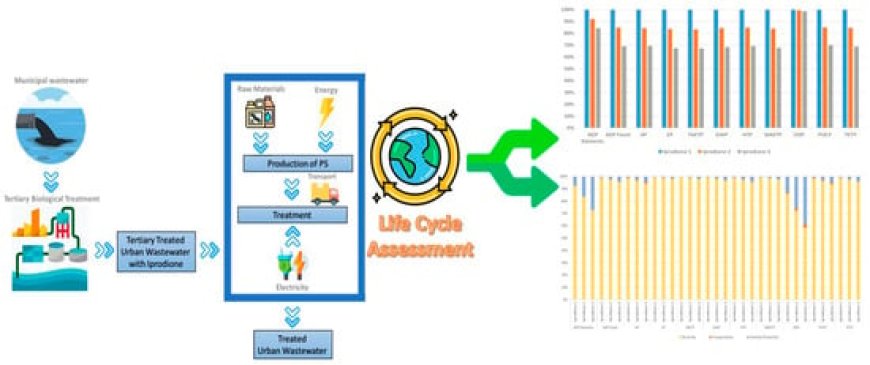
Water contamination with various micropollutants is a serious environmental concern since this group of chemicals cannot always be removed efficiently with advanced treatment methods. Therefore, alternative chemical- and energy-intensive oxidation processes have been proposed for the removal of refractory and/or toxic chemicals. However, similar treatment performances might result in different environmental impacts. Environmental impacts can be determined by adopting a life cycle assessment methodology. In this context, lab-scale experimental data related to 100% iprodione (a hydantoin fungicide/nematicide selected as the model micropollutant at a concentration of 2 mg/L) removal from simulated tertiary treated urban wastewater (dissolved organic carbon content = 10 mg/L) with UV-C-activated persulfate treatment were studied in terms of environmental impacts generated during photochemical treatment through the application of a life cycle assessment procedure. Standard guidelines were followed in this procedure. Iprodione removal was achieved at varying persulfate concentrations and UV-C doses; however, an “optimum” treatment condition (0.03 mM persulfate, 0.5 W/L UV-C) was experimentally established for kinetically acceptable, 100% iprodione removal in distilled water and adopted to treat iprodione in simulated tertiary treated wastewater (total dissolved organic carbon of iprodione + tertiary wastewater = 11.2 mg/L). The study findings indicated that energy input was the major contributor to all the environmental impact categories, namely global warming, abiotic depletion (fossil and elements), acidification, eutrophication, freshwater aquatic ecotoxicity, human toxicity, ozone depletion, photochemical ozone creation, and terrestrial ecotoxicity potentials. According to the life cycle assessment results, a concentration of 21.42 mg/L persulfate and an electrical energy input of 1.787 kWh/m3 (Wh/L) UV-C light yielded the lowest undesired environmental impacts among the examined photochemical treatment conditions.
Water, Vol. 16, Pages 1183: Life Cycle Assessment as a Decision-Making Tool for Photochemical Treatment of Iprodione Fungicide from Wastewater
Water doi: 10.3390/w16081183
Authors: Kubra Dogan Burcin Atilgan Turkmen Idil Arslan-Alaton Fatos Germirli Babuna
Water contamination with various micropollutants is a serious environmental concern since this group of chemicals cannot always be removed efficiently with advanced treatment methods. Therefore, alternative chemical- and energy-intensive oxidation processes have been proposed for the removal of refractory and/or toxic chemicals. However, similar treatment performances might result in different environmental impacts. Environmental impacts can be determined by adopting a life cycle assessment methodology. In this context, lab-scale experimental data related to 100% iprodione (a hydantoin fungicide/nematicide selected as the model micropollutant at a concentration of 2 mg/L) removal from simulated tertiary treated urban wastewater (dissolved organic carbon content = 10 mg/L) with UV-C-activated persulfate treatment were studied in terms of environmental impacts generated during photochemical treatment through the application of a life cycle assessment procedure. Standard guidelines were followed in this procedure. Iprodione removal was achieved at varying persulfate concentrations and UV-C doses; however, an “optimum” treatment condition (0.03 mM persulfate, 0.5 W/L UV-C) was experimentally established for kinetically acceptable, 100% iprodione removal in distilled water and adopted to treat iprodione in simulated tertiary treated wastewater (total dissolved organic carbon of iprodione + tertiary wastewater = 11.2 mg/L). The study findings indicated that energy input was the major contributor to all the environmental impact categories, namely global warming, abiotic depletion (fossil and elements), acidification, eutrophication, freshwater aquatic ecotoxicity, human toxicity, ozone depletion, photochemical ozone creation, and terrestrial ecotoxicity potentials. According to the life cycle assessment results, a concentration of 21.42 mg/L persulfate and an electrical energy input of 1.787 kWh/m3 (Wh/L) UV-C light yielded the lowest undesired environmental impacts among the examined photochemical treatment conditions.
What's Your Reaction?