Worldwide fertility rate from actual and predictions
Worldwide fertility rate from actual and predictions
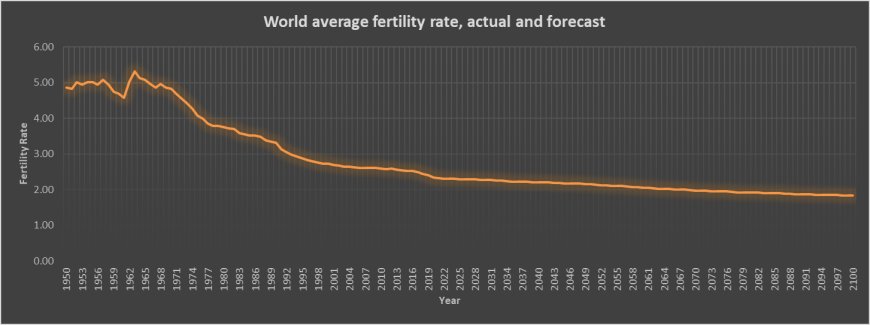
Worldwide Total Fertility Rate from 1950 to 2100
Presently, on a global scale, the average number of children expected to be born to a woman of childbearing age is approximately 2.3 throughout her lifetime. In earlier eras, prior to industrialization, women typically bore between five to ten children in their lifetime. However, with the advent of the demographic transition, fertility rates have markedly declined. This decline can be attributed to various factors such as the reduction in childhood mortality, leading to lesser need for compensatory childbirth, greater autonomy for women, and advancements in contraceptive methods and accessibility.
Recent Trends During the period spanning from the 1950s to the 1970s, the global fertility rate hovered around five children per woman. This was partly due to the post-World War II baby boom experienced in many nations, compounded by already high rates in less-developed regions. The dip observed circa 1960 can be linked to China's "Great Leap Forward," during which famine and disease caused a decrease of approximately 0.5 children per woman in the global fertility rate. From the 1970s onward to the present day, fertility rates have steadily decreased, albeit at a slower pace as the Baby Boomer generation began having their own children.
Replacement Level Fertility Replacement level fertility, defined as the number of children each woman in a population needs to bear for long-term population stability, is estimated at around 2.1 children per woman. Despite fertility rates falling below this threshold, populations may still experience natural growth due to decreased mortality rates and increased life expectancy. However, this growth will eventually plateau, leading to population decline. Projections suggest that the global fertility rate will dip below replacement level by the mid-2050s. Nonetheless, advancements in healthcare and living standards are anticipated to sustain population growth into the 2080s, after which a decline in the global population is expected.
Source: World Bank, OurWorldindata, Statista
What's Your Reaction?