


































Access to electricity percentage of population - Sub-Saharan Africa & world
Access to electricity percentage of population - Sub-Saharan Africa
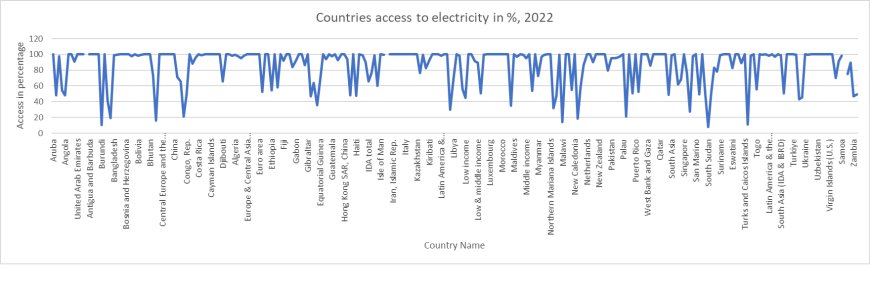
An escalating number of nations are progressively relying on dependable and secure electricity provisions to bolster economic advancement and communal well-being. This dependency is poised to intensify with the emergence of more efficient and environmentally friendly power sources aimed at decarbonizing economies.
Energy serves as the cornerstone for fostering economic growth, being indispensable for operating factories, sustaining commerce, cultivating crops, and facilitating goods distribution. Access to electricity holds particular significance in human development, as it is indispensable for essential tasks such as illumination, refrigeration, and household appliance operation, with limited alternatives available.
The availability of electricity to individuals stands out as one of the most lucid and undistorted indicators of a nation's energy poverty status. Consequently, electricity access has assumed a prominent position in the agendas of governments, particularly in developing nations.
This has led to the establishment of numerous rural electrification programs and national electrification agencies, aimed at more accurately assessing rural development and electrification needs and statuses. While energy utilization is crucial for enhancing living standards, electricity generation can also inflict environmental harm.
The extent of this damage hinges largely on the methods employed for electricity generation. For instance, coal combustion releases twice as much carbon dioxide—a key contributor to global warming—as burning an equivalent amount of natural gas.
Source: world Bank
What's Your Reaction?











