Earthquake Landscape in Ethiopia
Earthquake Landscape in Ethiopia
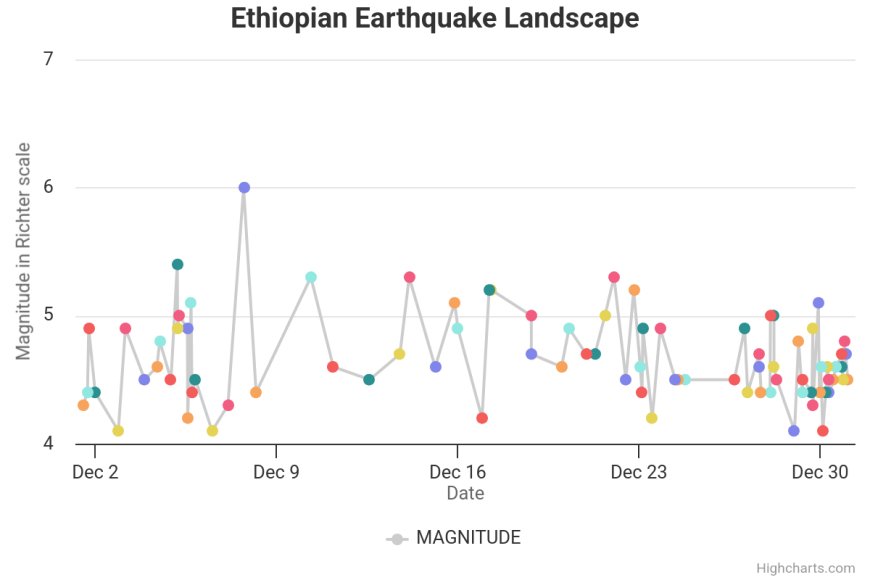
In late December 2024, Ethiopia experienced a series of moderate earthquakes concentrated primarily in the country's central and eastern regions. The most significant quake occurred on December 29, with a magnitude of 5.1, located at latitude 9.3 and longitude 40.09. This was followed by multiple aftershocks, many registering magnitudes between 4.4 and 4.9, indicating ongoing seismic activity in the area. These events occurred at a uniform depth of 10 kilometers, consistent with tectonic movements along Ethiopia's rift system, part of the East African Rift. The clustering of events around areas like 9°N to 10°N latitude highlights significant tectonic stress along this active geological boundary.
The sequence of earthquakes showcases the dynamic nature of Ethiopia's tectonic setting, driven by the divergence of the African and Somali tectonic plates. The towns near the epicenters likely felt mild to moderate shaking, but the relatively shallow depths of the quakes could have amplified ground motions locally. While no reports of severe damage or casualties have emerged from these events, the frequency and intensity of the quakes underline the importance of ongoing monitoring and preparedness in the region to mitigate potential risks from more significant seismic activity in the future.
There are safety cations to be taken during earthquake event. What you should do?
According to United States Geological Survey, these are recommended safety precaucions.
During an earthquake, your safety depends on your location and quick actions.
If you are indoors, stay there. Find cover under a sturdy desk or table and hold on (Drop, Cover, and Hold On!). Alternatively, move to a hallway or against an interior wall, staying clear of windows, fireplaces, and heavy furniture or appliances.
Avoid the kitchen, as falling items pose a significant risk. Do not run downstairs or rush outside during shaking, as this increases the danger of injury from falling debris or glass. If you are outdoors, move to an open area away from buildings, power lines, chimneys, and other potential hazards.
If driving, stop cautiously and pull over as far as possible from traffic. Avoid stopping on or under bridges, overpasses, or near trees, light posts, power lines, or signs.
Stay inside your car until the shaking stops, and once you resume driving, be alert for road damage, fallen rocks, and uneven surfaces at bridge approaches. In mountainous areas, be aware of falling rocks, landslides, trees, and other debris that earthquakes may dislodge. Prioritize safety and remain vigilant in any environment.
Source: usgs
What's Your Reaction?