CivilEng, Vol. 4, Pages 753-781: Use of Continuous Wavelet Transform to Generate Endurance Time Excitation Functions for Nonlinear Seismic Analysis of Structures
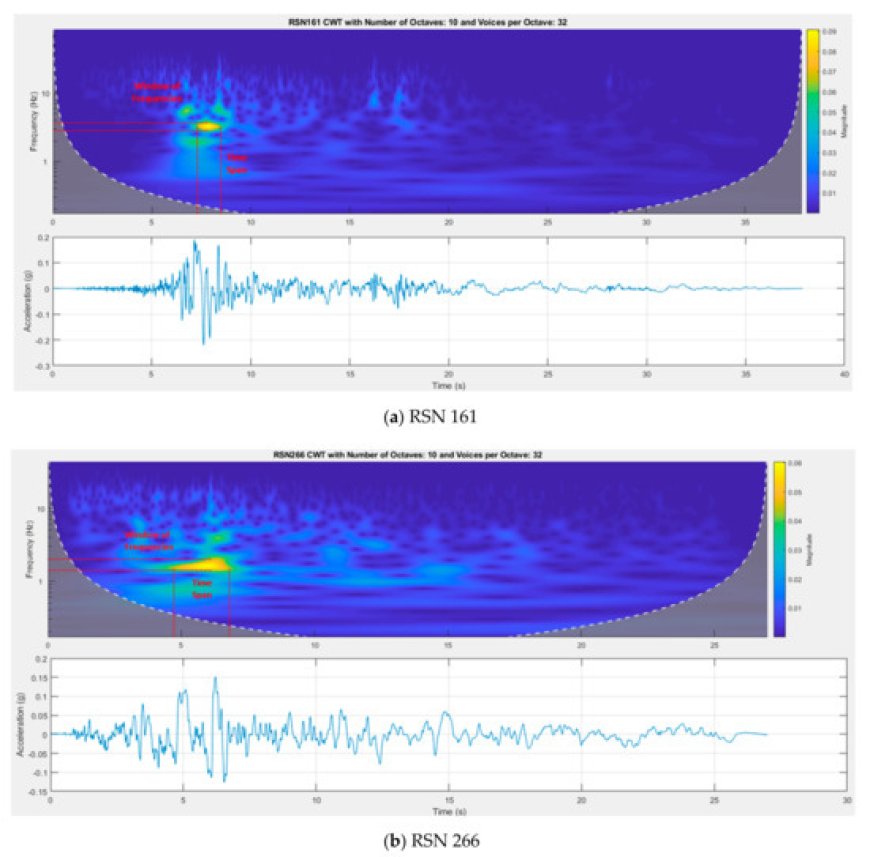
This paper presents the use of continuous wavelet transform (CWT) to capture the frequency contents, spectra of dominant frequencies and associated time durations of real earthquakes for generating artificial excitations to perform endurance time analysis (ETA) of structures. Applying CWT to three sets of forty earthquakes, the 90 percentile frequencies that span the ranges 0.08–18.41 Hz, 0.61–12.73 Hz, and 0.56–15.53 Hz; with associated time durations of 20, 15 and 16 s, respectively, for these earthquake sets are extracted. Artificial excitations that contain these ground motion characteristics are generated, progressively scaled up and applied to the target structure until failure. The scaling used is a block-shaped envelope that increases in size by a factor of 3/2 over time. Nonlinear seismic analyses of a steel frame and a concrete bridge bent using these artificial excitations have shown that the method not only successfully predicts the base shear–roof displacement responses of these structures, it also correctly identifies behavior such as weak story, concrete spalling, and core cracking. When compared with the increment dynamic analysis and time history analysis using multiple earthquakes, the proposed method is capable of producing comparable results with a significant reduction in computational time and a much smaller output file size.
CivilEng, Vol. 4, Pages 753-781: Use of Continuous Wavelet Transform to Generate Endurance Time Excitation Functions for Nonlinear Seismic Analysis of Structures
CivilEng doi: 10.3390/civileng4030043
Authors: Mohammadhossein Mamaghani Eric M. Lui
This paper presents the use of continuous wavelet transform (CWT) to capture the frequency contents, spectra of dominant frequencies and associated time durations of real earthquakes for generating artificial excitations to perform endurance time analysis (ETA) of structures. Applying CWT to three sets of forty earthquakes, the 90 percentile frequencies that span the ranges 0.08–18.41 Hz, 0.61–12.73 Hz, and 0.56–15.53 Hz; with associated time durations of 20, 15 and 16 s, respectively, for these earthquake sets are extracted. Artificial excitations that contain these ground motion characteristics are generated, progressively scaled up and applied to the target structure until failure. The scaling used is a block-shaped envelope that increases in size by a factor of 3/2 over time. Nonlinear seismic analyses of a steel frame and a concrete bridge bent using these artificial excitations have shown that the method not only successfully predicts the base shear–roof displacement responses of these structures, it also correctly identifies behavior such as weak story, concrete spalling, and core cracking. When compared with the increment dynamic analysis and time history analysis using multiple earthquakes, the proposed method is capable of producing comparable results with a significant reduction in computational time and a much smaller output file size.
What's Your Reaction?