Climate, Vol. 12, Pages 108: Conducting a Tailored and Localised Marine Heat Wave Risk Assessment for Vanuatu Fisheries
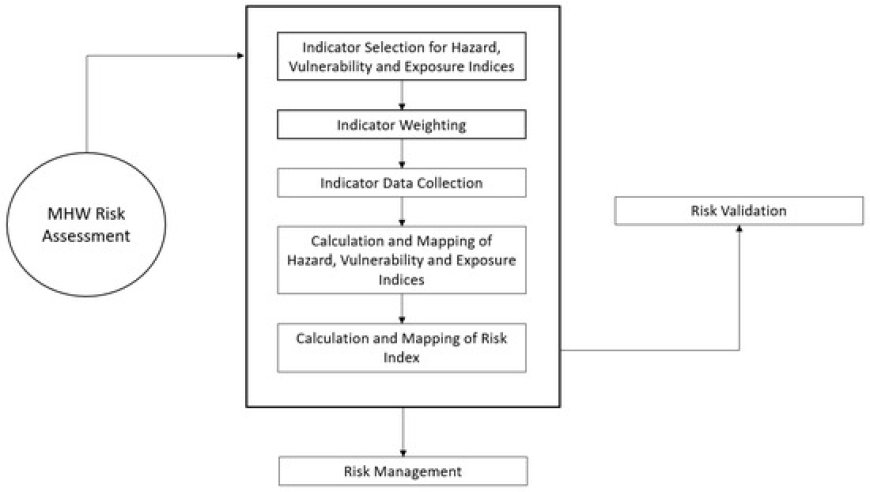
In Vanuatu, communities are predicted to be at high risk of more frequent and severe Marine Heat Wave (MHW) impacts in the future, as a result of climate change. A critical sector at risk in Vanuatu is fisheries, which vitally support food security and livelihoods. To sustain local communities, the MHW risk for Vanuatu fisheries must be extensively explored. In this study, an efficient MHW risk assessment methodology is demonstrated specifically for assessing MHW risk to Vanuatu fisheries. The fisheries specific MHW risk assessment was conducted on the local area council scale for two retrospective case study periods: 2015–2017 and 2020–2022. An integrated GIS-based approach was taken to calculating and mapping monthly hazard, vulnerability, exposure, and overall risk indices. Key areas and time periods of concern for MHW impacts are identified. Area councils in the Shefa province area are particularly concerning, displaying consistently high-risk levels throughout both case studies. Risk levels in 2022 were the most concerning, with most months displaying peak risk to MHW impacts. A sensitivity analysis is employed to validate the selection and weighting of the indicators used. However, it is recommended that a more comprehensive validation of the retrospective risk assessment results, using multiple ground-truth sources, be conducted in the future. Once results are sufficiently validated, management recommendations for fisheries resilience can be made.
Climate, Vol. 12, Pages 108: Conducting a Tailored and Localised Marine Heat Wave Risk Assessment for Vanuatu Fisheries
Climate doi: 10.3390/cli12080108
Authors: Isabella Aitkenhead Yuriy Kuleshov Chayn Sun Suelynn Choy
In Vanuatu, communities are predicted to be at high risk of more frequent and severe Marine Heat Wave (MHW) impacts in the future, as a result of climate change. A critical sector at risk in Vanuatu is fisheries, which vitally support food security and livelihoods. To sustain local communities, the MHW risk for Vanuatu fisheries must be extensively explored. In this study, an efficient MHW risk assessment methodology is demonstrated specifically for assessing MHW risk to Vanuatu fisheries. The fisheries specific MHW risk assessment was conducted on the local area council scale for two retrospective case study periods: 2015–2017 and 2020–2022. An integrated GIS-based approach was taken to calculating and mapping monthly hazard, vulnerability, exposure, and overall risk indices. Key areas and time periods of concern for MHW impacts are identified. Area councils in the Shefa province area are particularly concerning, displaying consistently high-risk levels throughout both case studies. Risk levels in 2022 were the most concerning, with most months displaying peak risk to MHW impacts. A sensitivity analysis is employed to validate the selection and weighting of the indicators used. However, it is recommended that a more comprehensive validation of the retrospective risk assessment results, using multiple ground-truth sources, be conducted in the future. Once results are sufficiently validated, management recommendations for fisheries resilience can be made.
What's Your Reaction?