CivilEng, Vol. 4, Pages 740-752: Simplified Method for Determining Thermal Stresses during the Construction of Massive Monolithic Foundation Slabs
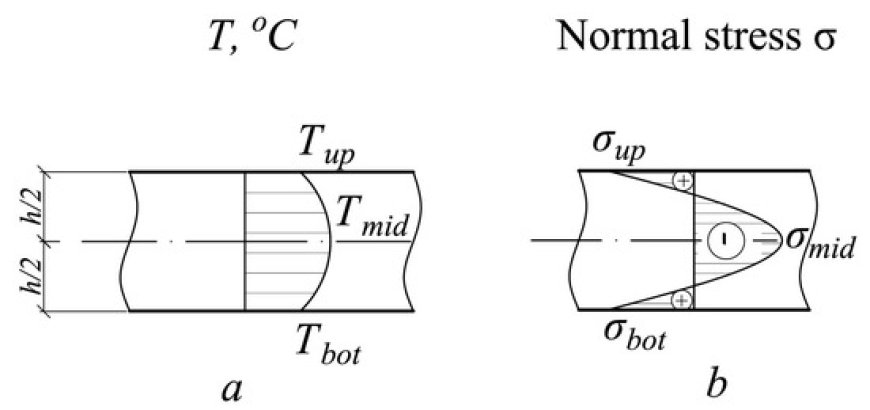
For massive monolithic foundation slabs, the problem of early cracking due to the intense heat release of concrete during the hardening process is relevant. The purpose of this article is to develop a simplified method for determining thermal stresses during the construction of massive monolithic foundation slabs. The proposed technique is based on the hypothesis of parabolic temperature distribution over the thickness of the structure at each moment of time. In addition to the parabolic distribution, the half-wave cosine distribution is also used. A hypothesis is also introduced about the same conditions of heat exchange with the environment on the lower and upper surfaces of the foundation. As a result, formulas are obtained that establish a direct relationship between thermal stresses and the temperature difference between the center and the surface. The solution to the test problem for the foundation slab is presented and compared with an alternative technique that does not use the hypothesis about the character of the temperature distribution over the thickness. Also, the inverse problem of determining the allowable temperature drop between the center and the surface of the structure is solved, at which the stresses on the upper surface at each moment of time will not exceed the tensile strength of concrete.
CivilEng, Vol. 4, Pages 740-752: Simplified Method for Determining Thermal Stresses during the Construction of Massive Monolithic Foundation Slabs
CivilEng doi: 10.3390/civileng4030042
Authors: Anton Chepurnenko Vasilina Turina
For massive monolithic foundation slabs, the problem of early cracking due to the intense heat release of concrete during the hardening process is relevant. The purpose of this article is to develop a simplified method for determining thermal stresses during the construction of massive monolithic foundation slabs. The proposed technique is based on the hypothesis of parabolic temperature distribution over the thickness of the structure at each moment of time. In addition to the parabolic distribution, the half-wave cosine distribution is also used. A hypothesis is also introduced about the same conditions of heat exchange with the environment on the lower and upper surfaces of the foundation. As a result, formulas are obtained that establish a direct relationship between thermal stresses and the temperature difference between the center and the surface. The solution to the test problem for the foundation slab is presented and compared with an alternative technique that does not use the hypothesis about the character of the temperature distribution over the thickness. Also, the inverse problem of determining the allowable temperature drop between the center and the surface of the structure is solved, at which the stresses on the upper surface at each moment of time will not exceed the tensile strength of concrete.
What's Your Reaction?