IJERPH, Vol. 21, Pages 558: The Impact of Climatic Factors on Temporal Mosquito Distribution and Population Dynamics in an Area Targeted for Sterile Insect Technique Pilot Trials
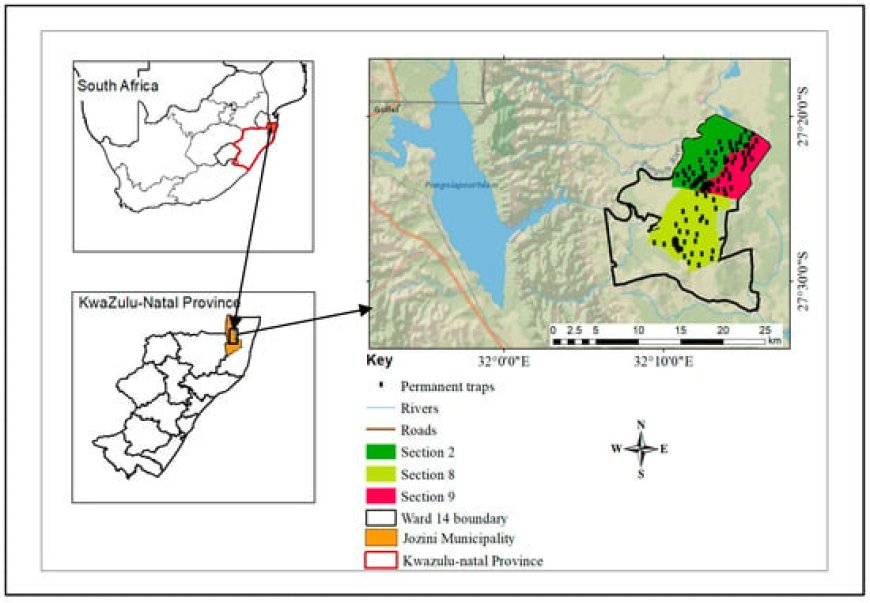
It is widely accepted that climate affects the mosquito life history traits; however, its precise role in determining mosquito distribution and population dynamics is not fully understood. This study aimed to investigate the influence of various climatic factors on the temporal distribution of Anopheles arabiensis populations in Mamfene, South Africa between 2014 and 2019. Time series analysis, wavelet analysis, cross-correlation analysis, and regression model combined with the autoregressive integrated moving average (ARIMA) model were utilized to assess the relationship between climatic factors and An. arabiensis population density. In total 3826 adult An. arabiensis collected was used for the analysis. ARIMA (0, 1, 2) (0, 0, 1)12 models closely described the trends observed in An. arabiensis population density and distribution. The wavelet coherence and time-lagged correlation analysis showed positive correlations between An. arabiensis population density and temperature (r = 0.537 ), humidity (r = 0.495) and rainfall (r = 0.298) whilst wind showed negative correlations (r = −0.466). The regression model showed that temperature (p = 0.00119), rainfall (p = 0.0436), and humidity (p = 0.0441) as significant predictors for forecasting An. arabiensis abundance. The extended ARIMA model (AIC = 102.08) was a better fit for predicting An. arabiensis abundance compared to the basic model. Anopheles arabiensis still remains the predominant malaria vector in the study area and climate variables were found to have varying effects on the distribution and abundance of An. arabiensis. This necessitates other complementary vector control strategies such as the Sterile Insect Technique (SIT) which involves releasing sterile males into the environment to reduce mosquito populations. This requires timely mosquito and climate information to precisely target releases and enhance the effectiveness of the program, consequently reducing the malaria risk.
IJERPH, Vol. 21, Pages 558: The Impact of Climatic Factors on Temporal Mosquito Distribution and Population Dynamics in an Area Targeted for Sterile Insect Technique Pilot Trials
International Journal of Environmental Research and Public Health doi: 10.3390/ijerph21050558
Authors: Theresa Taona Mazarire Leanne Lobb Solomon Wakshom Newete Givemore Munhenga
It is widely accepted that climate affects the mosquito life history traits; however, its precise role in determining mosquito distribution and population dynamics is not fully understood. This study aimed to investigate the influence of various climatic factors on the temporal distribution of Anopheles arabiensis populations in Mamfene, South Africa between 2014 and 2019. Time series analysis, wavelet analysis, cross-correlation analysis, and regression model combined with the autoregressive integrated moving average (ARIMA) model were utilized to assess the relationship between climatic factors and An. arabiensis population density. In total 3826 adult An. arabiensis collected was used for the analysis. ARIMA (0, 1, 2) (0, 0, 1)12 models closely described the trends observed in An. arabiensis population density and distribution. The wavelet coherence and time-lagged correlation analysis showed positive correlations between An. arabiensis population density and temperature (r = 0.537 ), humidity (r = 0.495) and rainfall (r = 0.298) whilst wind showed negative correlations (r = −0.466). The regression model showed that temperature (p = 0.00119), rainfall (p = 0.0436), and humidity (p = 0.0441) as significant predictors for forecasting An. arabiensis abundance. The extended ARIMA model (AIC = 102.08) was a better fit for predicting An. arabiensis abundance compared to the basic model. Anopheles arabiensis still remains the predominant malaria vector in the study area and climate variables were found to have varying effects on the distribution and abundance of An. arabiensis. This necessitates other complementary vector control strategies such as the Sterile Insect Technique (SIT) which involves releasing sterile males into the environment to reduce mosquito populations. This requires timely mosquito and climate information to precisely target releases and enhance the effectiveness of the program, consequently reducing the malaria risk.
What's Your Reaction?