IJERPH, Vol. 21, Pages 547: Clinical and Neuroimaging Predictors of Alzheimer’s Dementia Conversion in Patients with Mild Cognitive Impairment Using Amyloid Positron Emission Tomography by Quantitative Analysis over 2 Years
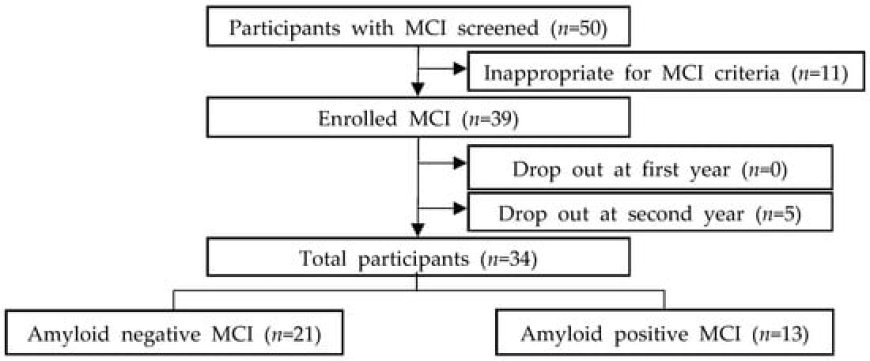
Patients with mild cognitive impairment (MCI) have a relatively high risk of developing Alzheimer’s dementia (AD), so early identification of the risk for AD conversion can lessen the socioeconomic burden. In this study, 18F-Florapronol, newly developed in Korea, was used for qualitative and quantitative analyses to assess amyloid positivity. We also investigated the clinical predictors of the progression from MCI to dementia over 2 years. From December 2019 to December 2022, 50 patients with MCI were recruited at a single center, and 34 patients were included finally. Based on visual analysis, 13 (38.2%) of 34 participants were amyloid-positive, and 12 (35.3%) were positive by quantitative analysis. Moreover, 6 of 34 participants (17.6%) converted to dementia after a 2-year follow-up (p = 0.173). Among the 15 participants who were positive for amyloid in the posterior cingulate region, 5 (33.3%) patients developed dementia (p = 0.066). The Clinical Dementia Rating-Sum of Boxes (CDR-SOB) at baseline was significantly associated with AD conversion in multivariate Cox regression analyses (p = 0.043). In conclusion, these results suggest that amyloid positivity in the posterior cingulate region and higher CDR-SOB scores at baseline can be useful predictors of AD conversion in patients with MCI.
IJERPH, Vol. 21, Pages 547: Clinical and Neuroimaging Predictors of Alzheimer’s Dementia Conversion in Patients with Mild Cognitive Impairment Using Amyloid Positron Emission Tomography by Quantitative Analysis over 2 Years
International Journal of Environmental Research and Public Health doi: 10.3390/ijerph21050547
Authors: Seonjeong Kim Daye Yoon Junho Seong Young Jin Jeong Do-Young Kang Kyung Won Park
Patients with mild cognitive impairment (MCI) have a relatively high risk of developing Alzheimer’s dementia (AD), so early identification of the risk for AD conversion can lessen the socioeconomic burden. In this study, 18F-Florapronol, newly developed in Korea, was used for qualitative and quantitative analyses to assess amyloid positivity. We also investigated the clinical predictors of the progression from MCI to dementia over 2 years. From December 2019 to December 2022, 50 patients with MCI were recruited at a single center, and 34 patients were included finally. Based on visual analysis, 13 (38.2%) of 34 participants were amyloid-positive, and 12 (35.3%) were positive by quantitative analysis. Moreover, 6 of 34 participants (17.6%) converted to dementia after a 2-year follow-up (p = 0.173). Among the 15 participants who were positive for amyloid in the posterior cingulate region, 5 (33.3%) patients developed dementia (p = 0.066). The Clinical Dementia Rating-Sum of Boxes (CDR-SOB) at baseline was significantly associated with AD conversion in multivariate Cox regression analyses (p = 0.043). In conclusion, these results suggest that amyloid positivity in the posterior cingulate region and higher CDR-SOB scores at baseline can be useful predictors of AD conversion in patients with MCI.
What's Your Reaction?