Climate, Vol. 11, Pages 232: Tropical Cyclonic Energy Variability in North Indian Ocean: Insights from ENSO
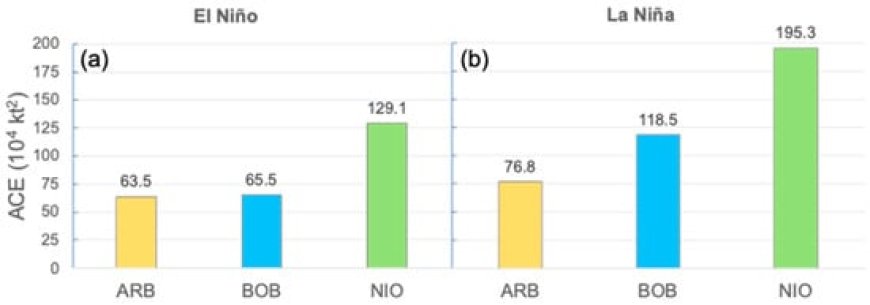
Tropical cyclones (TC) are one of the deadliest natural meteorological hazards with destructive winds and heavy rains, resulting losses often reach billions of dollars, imposing a substantial and long-lasting burden on both local and national economies. The El-Niño Southern Oscillation (ENSO), a tropical ocean–atmosphere interaction, is known to significantly impact cyclonic systems over global ocean basins. This study investigates the variability of TC activity in the presence of ENSO over the North Indian Ocean (NIO), comprising the Arabian Sea (ARB) and the Bay of Bengal (BOB) basins during the pre- and post-monsoon season, using accumulated cyclone energy (ACE) over the last 29 years. Our analysis reveals a significant rise in tropical cyclone energy intensity over the past two decades, with eight of the ten most active years occurring since the 2000s. Total ACE over the NIO is found to be higher in La-Niña. Higher ACE observed over ARB is strongly associated with a combination of elevated sea surface height (SSH) anomaly and low vertical wind shear during the El-Niño episodes, with higher sea surface temperatures (SST) during the post-monsoon season. Whereas in the BOB, El Niño not only reduces ACE, but also decreases basin-wide variability, and more pronounced effects during the post-monsoon season, coinciding with warmer SST and higher SSH along the coast during La-Niña.
Climate, Vol. 11, Pages 232: Tropical Cyclonic Energy Variability in North Indian Ocean: Insights from ENSO
Climate doi: 10.3390/cli11120232
Authors: Debanjana Das Sen Chiao Chayan Roychoudhury Fatema Khan Sutapa Chaudhuri Sayantika Mukherjee
Tropical cyclones (TC) are one of the deadliest natural meteorological hazards with destructive winds and heavy rains, resulting losses often reach billions of dollars, imposing a substantial and long-lasting burden on both local and national economies. The El-Niño Southern Oscillation (ENSO), a tropical ocean–atmosphere interaction, is known to significantly impact cyclonic systems over global ocean basins. This study investigates the variability of TC activity in the presence of ENSO over the North Indian Ocean (NIO), comprising the Arabian Sea (ARB) and the Bay of Bengal (BOB) basins during the pre- and post-monsoon season, using accumulated cyclone energy (ACE) over the last 29 years. Our analysis reveals a significant rise in tropical cyclone energy intensity over the past two decades, with eight of the ten most active years occurring since the 2000s. Total ACE over the NIO is found to be higher in La-Niña. Higher ACE observed over ARB is strongly associated with a combination of elevated sea surface height (SSH) anomaly and low vertical wind shear during the El-Niño episodes, with higher sea surface temperatures (SST) during the post-monsoon season. Whereas in the BOB, El Niño not only reduces ACE, but also decreases basin-wide variability, and more pronounced effects during the post-monsoon season, coinciding with warmer SST and higher SSH along the coast during La-Niña.
What's Your Reaction?