












Hydrology, Vol. 10, Pages 238: Evaluating the Benefits of Flood Warnings in the Management of an Urban Flood-Prone Polder Area
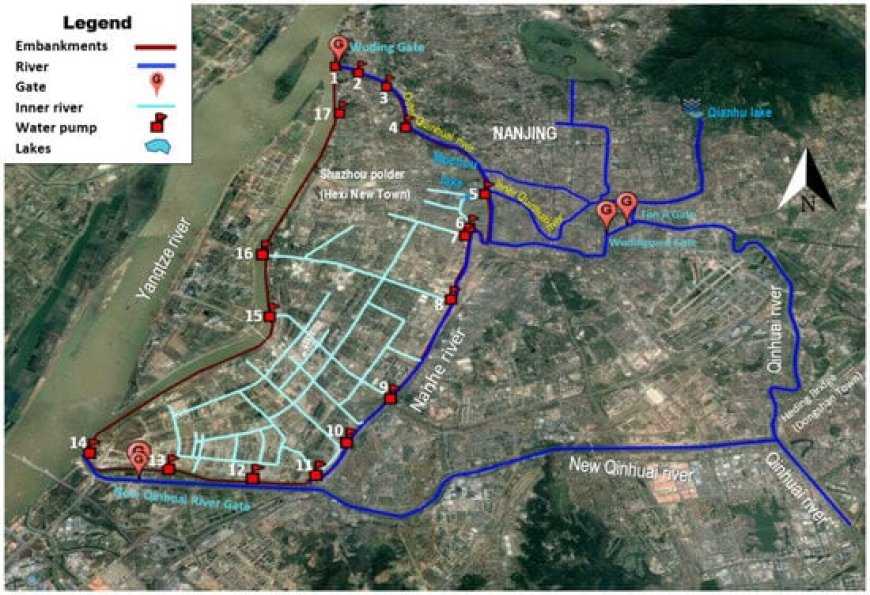
Polders are low-lying areas located in deltas, surrounded by embankments to prevent flooding (river or tidal floods). They rely on pumping systems to remove water from the inner rivers (artificial rivers inside the polder area) to the outer rivers, especially during storms. Urbanized polders are especially vulnerable to pluvial flooding if the drainage, storage, and pumping capacity of the polder is inadequate. In this paper, a Monte Carlo (MC) framework is proposed to evaluate the benefits of rainfall threshold-based flood warnings when mitigating pluvial flooding in an urban flood-prone polder area based on 24 h forecasts. The framework computes metrics that give the potential waterlogging duration, maximum inundated area, and pump operation costs by considering the full range of potential storms. The benefits of flood warnings are evaluated by comparing the values of these metrics across different scenarios: the no-warning, perfect, deterministic, and probabilistic forecast scenarios. Probabilistic forecasts are represented using the concept of “predictive uncertainty” (PU). A polder area located in Nanjing was chosen for the case study. The results show a trade-off between the metrics that represent the waterlogging and the pumping costs, and that probabilistic forecasts of rainfall can considerably enhance these metrics. The results can be used to design a rainfall threshold-based flood early warning system (FEWS) for a polder area and/or evaluate its benefits.
Hydrology, Vol. 10, Pages 238: Evaluating the Benefits of Flood Warnings in the Management of an Urban Flood-Prone Polder Area
Hydrology doi: 10.3390/hydrology10120238
Authors: Felipe Duque Greg O’Donnell Yanli Liu Mingming Song Enda O’Connell
Polders are low-lying areas located in deltas, surrounded by embankments to prevent flooding (river or tidal floods). They rely on pumping systems to remove water from the inner rivers (artificial rivers inside the polder area) to the outer rivers, especially during storms. Urbanized polders are especially vulnerable to pluvial flooding if the drainage, storage, and pumping capacity of the polder is inadequate. In this paper, a Monte Carlo (MC) framework is proposed to evaluate the benefits of rainfall threshold-based flood warnings when mitigating pluvial flooding in an urban flood-prone polder area based on 24 h forecasts. The framework computes metrics that give the potential waterlogging duration, maximum inundated area, and pump operation costs by considering the full range of potential storms. The benefits of flood warnings are evaluated by comparing the values of these metrics across different scenarios: the no-warning, perfect, deterministic, and probabilistic forecast scenarios. Probabilistic forecasts are represented using the concept of “predictive uncertainty” (PU). A polder area located in Nanjing was chosen for the case study. The results show a trade-off between the metrics that represent the waterlogging and the pumping costs, and that probabilistic forecasts of rainfall can considerably enhance these metrics. The results can be used to design a rainfall threshold-based flood early warning system (FEWS) for a polder area and/or evaluate its benefits.
What's Your Reaction?