CivilEng, Vol. 3, Pages 998-1012: Optimization of Workability and Compressive Strength of Self-Compacting Mortar Using Screening Design
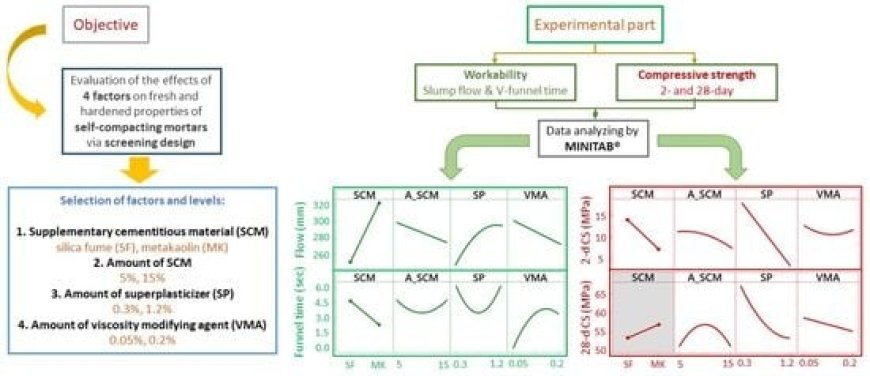
In this study, the significance of several factors in the performance of self-compacting mortar was statistically investigated. A screening design was used as a suitable design to identify the most important factors that can affect workability and compressive strength. The purpose of the study was to obtain the optimal conditions which can lead to optimal workability (slump flow, funnel time) and maximal compressive strength (2 and 28 days). Four experimental factors each at two levels, the type of supplementary cementitious material (SCM) as silica fume (SF) and metakaolin (MK); the amount of (SCM) at 5% and 15%; superplasticizer (SP) at 0.3% and 1.2% and viscosity modifying agent (VMA) at 0.05% and 0.2% were selected as potential candidates affecting the experimental outputs. The analysis of the data to obtain optimal values of the outputs was carried out by using MINITAB®. To establish the factor levels selected in this study in order to achieve optimal workability and maximal compressive strength, response optimization was applied. The predicted conditions for optimal workability were found to be 8.84% SF, 1.2% SP and 0.15% VMA. The solution proposed to maximize the compressive strength was 0.3% SP, 0.05% VMA and 9% or 9.75% SF for 2 and 28 days, respectively. By setting the factors at the specified levels, experimental values of the slump flow at 278 mm; funnel time at 8.3 s; 2- and 28-day compressive strength at 22.8 and 66.1 MPa were achieved. This resulted in the predicted and experimental values at the optimum conditions being in strong agreement.
CivilEng, Vol. 3, Pages 998-1012: Optimization of Workability and Compressive Strength of Self-Compacting Mortar Using Screening Design
CivilEng doi: 10.3390/civileng3040056
Authors: Anxhelina Qorllari Thomas A. Bier
In this study, the significance of several factors in the performance of self-compacting mortar was statistically investigated. A screening design was used as a suitable design to identify the most important factors that can affect workability and compressive strength. The purpose of the study was to obtain the optimal conditions which can lead to optimal workability (slump flow, funnel time) and maximal compressive strength (2 and 28 days). Four experimental factors each at two levels, the type of supplementary cementitious material (SCM) as silica fume (SF) and metakaolin (MK); the amount of (SCM) at 5% and 15%; superplasticizer (SP) at 0.3% and 1.2% and viscosity modifying agent (VMA) at 0.05% and 0.2% were selected as potential candidates affecting the experimental outputs. The analysis of the data to obtain optimal values of the outputs was carried out by using MINITAB®. To establish the factor levels selected in this study in order to achieve optimal workability and maximal compressive strength, response optimization was applied. The predicted conditions for optimal workability were found to be 8.84% SF, 1.2% SP and 0.15% VMA. The solution proposed to maximize the compressive strength was 0.3% SP, 0.05% VMA and 9% or 9.75% SF for 2 and 28 days, respectively. By setting the factors at the specified levels, experimental values of the slump flow at 278 mm; funnel time at 8.3 s; 2- and 28-day compressive strength at 22.8 and 66.1 MPa were achieved. This resulted in the predicted and experimental values at the optimum conditions being in strong agreement.
What's Your Reaction?