Hydrology, Vol. 11, Pages 37: Insight into Sources of Benzene, TCE, and PFOA/PFOS in Groundwater at Naval Air Station Whiting Field, Florida, through Numerical Particle-Tracking Simulations
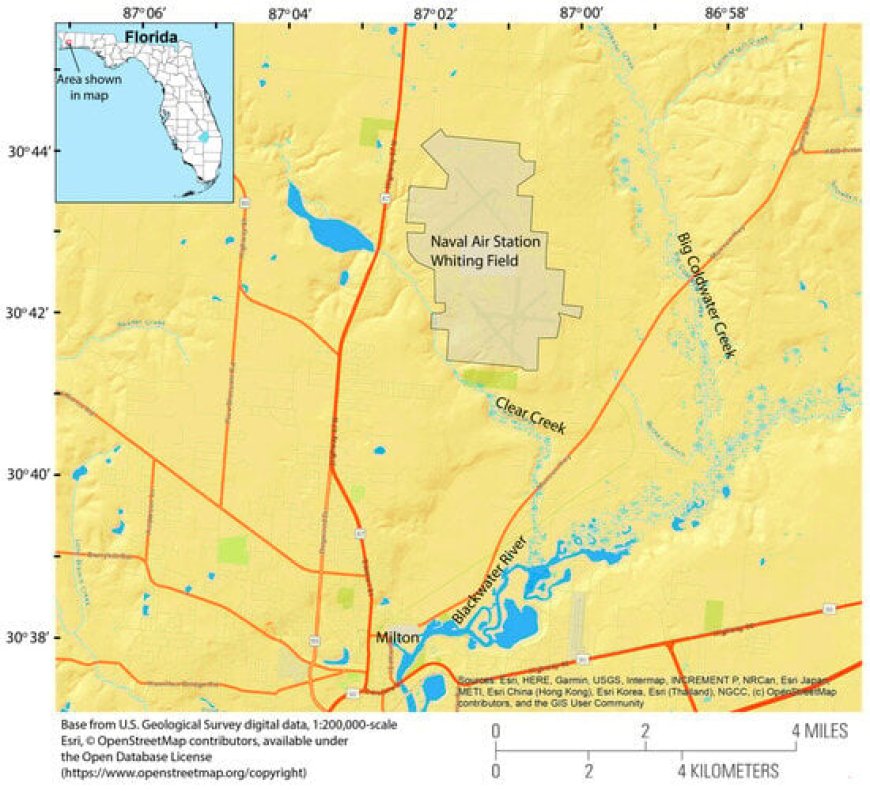
Past waste-disposal activities at Naval Air Station Whiting Field (NASWF) have led to elevated concentrations of contaminants in the underlying sand and gravel aquifer. Contaminants include two of the most commonly detected chemicals in groundwater in many countries (benzene and trichloroethylene (TCE)) and the “forever chemicals” per- and poly-fluoroalkyl substances (PFAS) such as perfluorooctanoic acid (PFOA) and perfluorooctane sulfonic acid (PFOS). A MODFLOW model (the Whiting Field Groundwater Model (WFGM)) was previously developed for NASWF and the surrounding area to simulate groundwater flow. To obtain insight into groundwater flow pathways for the identification of potential source areas, the MODPATH particle-tracking application was applied to the WFGM for three public supply wells and three monitoring wells at NASWF. The travel time to recharge areas was estimated using concentrations of the groundwater age-dating solutes tritium (as helium ingrowth) and chlorofluorocarbons detected in the monitoring wells. Simulated travel times agree with the groundwater ages and indicate that the calibrated WFGM reasonably represents groundwater flow velocities and pathways. The MODPATH simulations confirm suspected on-base source areas to explain chemical detection in the monitoring wells. In contrast, the particle-tracking simulations indicate that potential source areas to the public supply wells include both on- and off-base sources. This is important because PFAS chemicals can have multiple sources, including land application of sludge-based fertilizers. This approach that combines groundwater age dating with particle-tracking simulations can be applied at similar sites characterized by benzene-, TCE-, and PFAS-contaminated groundwater.
Hydrology, Vol. 11, Pages 37: Insight into Sources of Benzene, TCE, and PFOA/PFOS in Groundwater at Naval Air Station Whiting Field, Florida, through Numerical Particle-Tracking Simulations
Hydrology doi: 10.3390/hydrology11030037
Authors: Eric D. Swain James E. Landmeyer Michael A. Singletary Shannon E. Provenzano
Past waste-disposal activities at Naval Air Station Whiting Field (NASWF) have led to elevated concentrations of contaminants in the underlying sand and gravel aquifer. Contaminants include two of the most commonly detected chemicals in groundwater in many countries (benzene and trichloroethylene (TCE)) and the “forever chemicals” per- and poly-fluoroalkyl substances (PFAS) such as perfluorooctanoic acid (PFOA) and perfluorooctane sulfonic acid (PFOS). A MODFLOW model (the Whiting Field Groundwater Model (WFGM)) was previously developed for NASWF and the surrounding area to simulate groundwater flow. To obtain insight into groundwater flow pathways for the identification of potential source areas, the MODPATH particle-tracking application was applied to the WFGM for three public supply wells and three monitoring wells at NASWF. The travel time to recharge areas was estimated using concentrations of the groundwater age-dating solutes tritium (as helium ingrowth) and chlorofluorocarbons detected in the monitoring wells. Simulated travel times agree with the groundwater ages and indicate that the calibrated WFGM reasonably represents groundwater flow velocities and pathways. The MODPATH simulations confirm suspected on-base source areas to explain chemical detection in the monitoring wells. In contrast, the particle-tracking simulations indicate that potential source areas to the public supply wells include both on- and off-base sources. This is important because PFAS chemicals can have multiple sources, including land application of sludge-based fertilizers. This approach that combines groundwater age dating with particle-tracking simulations can be applied at similar sites characterized by benzene-, TCE-, and PFAS-contaminated groundwater.
What's Your Reaction?