Environments, Vol. 11, Pages 4: A Scoping Review of the Effects of Ambient Air Quality on Cognitive Frailty
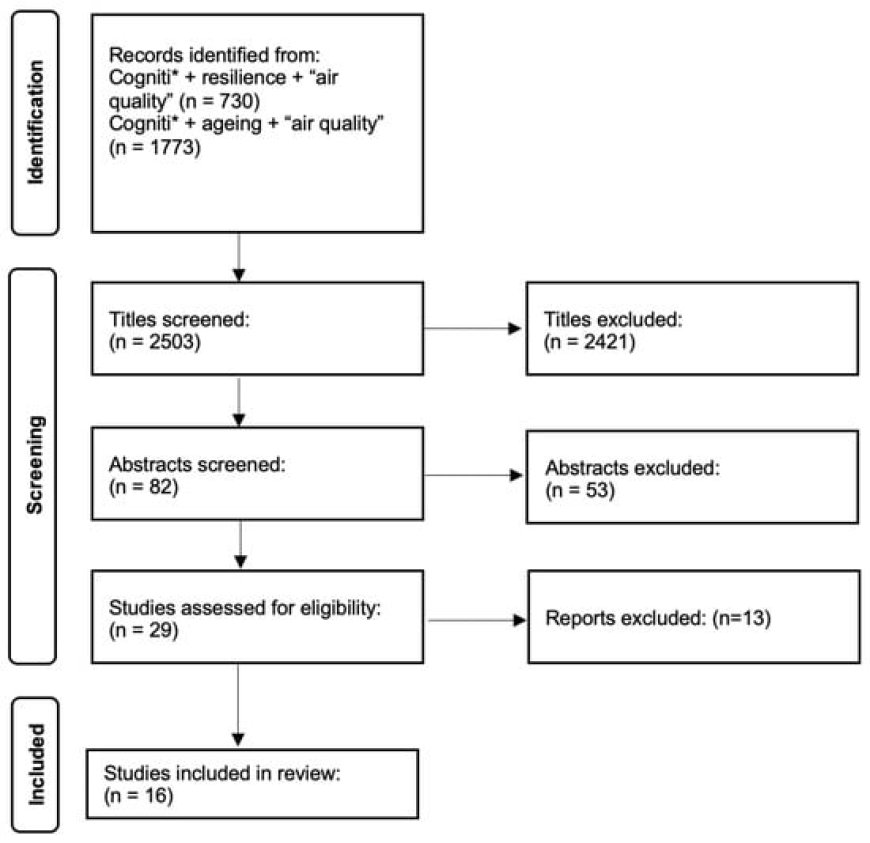
Environmental and public health research has given considerable attention to the impact of air quality on brain health, with systematic reviews being widespread. No literature review has been conducted for cognitive frailty—a multidimensional syndrome combining physical frailty and cognitive impairment and their apparent co-dependence, linked to increased vulnerability and adverse health outcomes, including dementia. Instead, cognitive decline and frailty are implicitly explored through research on air quality and comorbid cognitive and physical decline in elderly populations. A scoping review was conducted to explore the need for a systematic review. Combining the Arksey and O’Malley, and PRISMA-ScR checklist, a scoping review of SCOPUS using ‘cogniti*’ + ‘resilience’ + ‘air quality’ or ‘cogniti*’ + ‘ageing’ + ‘air quality’ resulted in n = 2503 articles, screened and reduced using inclusion and exclusion criteria, to n = 16 articles. Air quality appears to be a critical risk factor for cognitive decline, even at air quality levels below WHO targets. Moderate long-term ambient air pollution appears linked to increased risk of cognitive frailty, suggesting earlier and more active interventions to protect older people. There are varied effects on cognition across the life course, with both emotional and functional impacts. Effects may be more detrimental to elderly people with existing conditions, including economic and health inequalities. Generalisation of results is limited due to the absence of a dose–response, variations in methods, controlling for comorbid effects, and variance across studies. No literature review has been performed for cognitive frailty, largely due to the fact that it is not presently treated as an explicit outcome. The findings support the need for more research and a more extensive summary of the literature but suggest that there is worsening cognitive function over the life course as a result of increased PM2.5 concentrations. Furthermore, air quality appears to be a critical risk factor even at levels below World Health Organisation targets.
Environments, Vol. 11, Pages 4: A Scoping Review of the Effects of Ambient Air Quality on Cognitive Frailty
Environments doi: 10.3390/environments11010004
Authors: James Robert Hodgson Charlotte Benkowitz Brian C. Castellani Amanda Ellison Rammina Yassaie Helen Twohig Roshni Bhudia Otto-Emil Ilmari Jutila Sally Fowler-Davis
Environmental and public health research has given considerable attention to the impact of air quality on brain health, with systematic reviews being widespread. No literature review has been conducted for cognitive frailty—a multidimensional syndrome combining physical frailty and cognitive impairment and their apparent co-dependence, linked to increased vulnerability and adverse health outcomes, including dementia. Instead, cognitive decline and frailty are implicitly explored through research on air quality and comorbid cognitive and physical decline in elderly populations. A scoping review was conducted to explore the need for a systematic review. Combining the Arksey and O’Malley, and PRISMA-ScR checklist, a scoping review of SCOPUS using ‘cogniti*’ + ‘resilience’ + ‘air quality’ or ‘cogniti*’ + ‘ageing’ + ‘air quality’ resulted in n = 2503 articles, screened and reduced using inclusion and exclusion criteria, to n = 16 articles. Air quality appears to be a critical risk factor for cognitive decline, even at air quality levels below WHO targets. Moderate long-term ambient air pollution appears linked to increased risk of cognitive frailty, suggesting earlier and more active interventions to protect older people. There are varied effects on cognition across the life course, with both emotional and functional impacts. Effects may be more detrimental to elderly people with existing conditions, including economic and health inequalities. Generalisation of results is limited due to the absence of a dose–response, variations in methods, controlling for comorbid effects, and variance across studies. No literature review has been performed for cognitive frailty, largely due to the fact that it is not presently treated as an explicit outcome. The findings support the need for more research and a more extensive summary of the literature but suggest that there is worsening cognitive function over the life course as a result of increased PM2.5 concentrations. Furthermore, air quality appears to be a critical risk factor even at levels below World Health Organisation targets.
What's Your Reaction?