Environments, Vol. 11, Pages 3: A Comparative Study on the Removal of Microcystis and Cylindrospermopsis Blooms in Two Lakes by Flocculation–Filtration Treatment
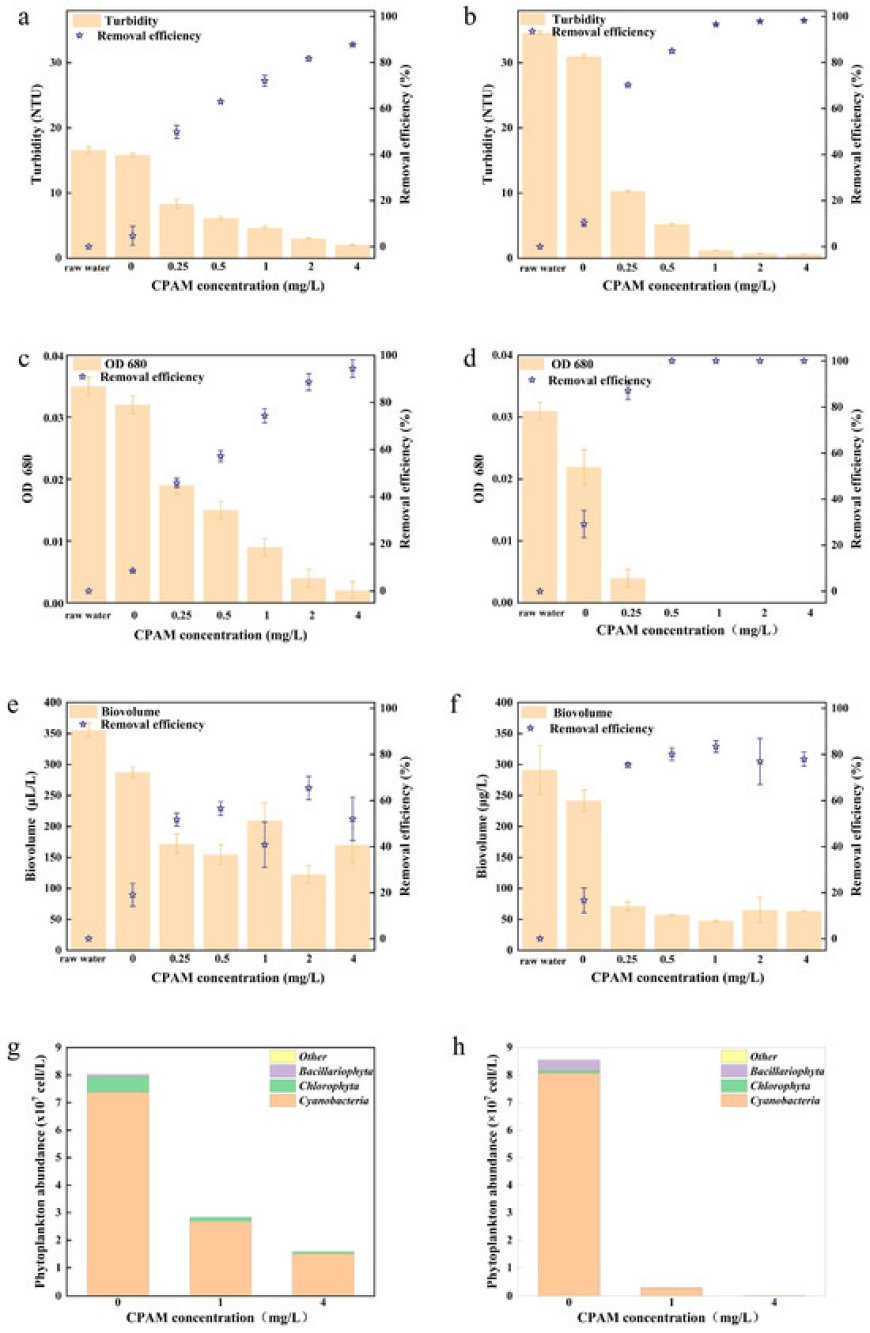
Dianchi Lake and Yilong Lake, two prominent plateau lakes in Yunnan Province, China, have suffered from Microcystis and Cylindrospermopsis blooms for decades. While cyanobacteria harvest boats utilizing cationic polyacrylamide (CPAM) flocculation and screen filtration have been proven effective for harvesting Microcystis biomass in Dianchi Lake, they struggle against Cylindrospermopsis blooms in Yilong Lake. This study systematically compared the removal of Microcystis and Cylindrospermopsis blooms using flocculation–filtration treatment, aiming to identify key factors influencing flocculation and propose enhancements to improve treatment efficiency for Cylindrospermopsis blooms. The reduction of turbidity, OD680, biovolume and phytoplankton density all revealed significantly better treatment efficiency for Microcystis blooms compared to Cylindrospermopsis blooms. In Dianchi Lake, 1 mg/L CPAM achieved a 95% turbidity reduction, while in Yilong Lake, even with 4.0 mg/L CPAM, the removal efficiency remained below 90%. Post-treatment, Dianchi Lake’s water quality showed substantial improvements, including over 50% reductions in total nitrogen, total phosphorus, permanganate index, and chemical oxygen demand. Conversely, nutrient level reductions were limited in Yilong Lake’s treated water. The average molecular weight of dissolved organic matters (DOM) in Yilong Lake was notably smaller than in Dianchi Lake. The treatment selectively removed high molecular weight, microbial-sourced, and protein-like DOM components, leading to a decrease in average molecular weight and an increase in humification index (HIX) in both lakes. Excessive humic matters in the water of Yilong Lake was found to hamper algae flocculation significantly. Introducing additional acidic polysaccharides or oxidants emerged as potential strategies to enhance Yilong Lake’s treatment efficiency.
Environments, Vol. 11, Pages 3: A Comparative Study on the Removal of Microcystis and Cylindrospermopsis Blooms in Two Lakes by Flocculation–Filtration Treatment
Environments doi: 10.3390/environments11010003
Authors: Cheng Zhou Sisi Deng Lei Xu Xiang Liu Chunbo Wang Junjun Chang
Dianchi Lake and Yilong Lake, two prominent plateau lakes in Yunnan Province, China, have suffered from Microcystis and Cylindrospermopsis blooms for decades. While cyanobacteria harvest boats utilizing cationic polyacrylamide (CPAM) flocculation and screen filtration have been proven effective for harvesting Microcystis biomass in Dianchi Lake, they struggle against Cylindrospermopsis blooms in Yilong Lake. This study systematically compared the removal of Microcystis and Cylindrospermopsis blooms using flocculation–filtration treatment, aiming to identify key factors influencing flocculation and propose enhancements to improve treatment efficiency for Cylindrospermopsis blooms. The reduction of turbidity, OD680, biovolume and phytoplankton density all revealed significantly better treatment efficiency for Microcystis blooms compared to Cylindrospermopsis blooms. In Dianchi Lake, 1 mg/L CPAM achieved a 95% turbidity reduction, while in Yilong Lake, even with 4.0 mg/L CPAM, the removal efficiency remained below 90%. Post-treatment, Dianchi Lake’s water quality showed substantial improvements, including over 50% reductions in total nitrogen, total phosphorus, permanganate index, and chemical oxygen demand. Conversely, nutrient level reductions were limited in Yilong Lake’s treated water. The average molecular weight of dissolved organic matters (DOM) in Yilong Lake was notably smaller than in Dianchi Lake. The treatment selectively removed high molecular weight, microbial-sourced, and protein-like DOM components, leading to a decrease in average molecular weight and an increase in humification index (HIX) in both lakes. Excessive humic matters in the water of Yilong Lake was found to hamper algae flocculation significantly. Introducing additional acidic polysaccharides or oxidants emerged as potential strategies to enhance Yilong Lake’s treatment efficiency.
What's Your Reaction?