Water, Vol. 16, Pages 1239: Identification of Trends in Dam Monitoring Data Series Based on Machine Learning and Individual Conditional Expectation Curves
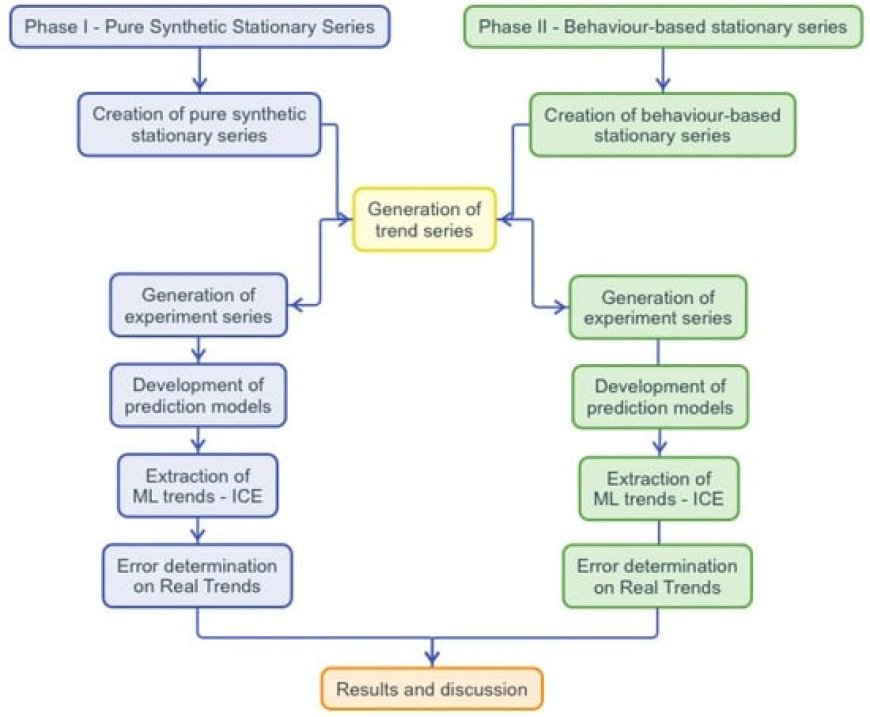
Dams are complex systems that involve both the structure itself and its foundation. Rheological phenomena, expansive reactions, or alterations in the geotechnical parameters of the foundation, among others, result in non-reversible and cumulative modifications in the dam response, leading to trends in the monitoring data series. The accurate identification and definition of these trends to study their evolution are key aspects of dam safety. This manuscript proposes a methodology to identify trends in dam behavioural data series by identifying the influence of the time variable on the predictions provided by the ML models. Initially, ICE curves and SHAP values are employed to extract temporal dependence, and the ICE curves are found to be more precise and efficient in terms of computational cost. The temporal dependencies found are adjusted using a GWO algorithm to different function characteristics of irreversible processes in dams. The function that provides the best fit is selected as the most plausible. The results obtained allow us to conclude that the proposed methodology is capable of obtaining estimates of the most common trends that affect movements in concrete dams with greater precision than the statistical models most commonly used to predict the behaviour of these types of variables. These results are promising for its general application to other types of dam monitoring data series, given the versatility demonstrated for the unsupervised identification of temporal dependencies.
Water, Vol. 16, Pages 1239: Identification of Trends in Dam Monitoring Data Series Based on Machine Learning and Individual Conditional Expectation Curves
Water doi: 10.3390/w16091239
Authors: Miguel Á. Fernández-Centeno Patricia Alocén Miguel Á. Toledo
Dams are complex systems that involve both the structure itself and its foundation. Rheological phenomena, expansive reactions, or alterations in the geotechnical parameters of the foundation, among others, result in non-reversible and cumulative modifications in the dam response, leading to trends in the monitoring data series. The accurate identification and definition of these trends to study their evolution are key aspects of dam safety. This manuscript proposes a methodology to identify trends in dam behavioural data series by identifying the influence of the time variable on the predictions provided by the ML models. Initially, ICE curves and SHAP values are employed to extract temporal dependence, and the ICE curves are found to be more precise and efficient in terms of computational cost. The temporal dependencies found are adjusted using a GWO algorithm to different function characteristics of irreversible processes in dams. The function that provides the best fit is selected as the most plausible. The results obtained allow us to conclude that the proposed methodology is capable of obtaining estimates of the most common trends that affect movements in concrete dams with greater precision than the statistical models most commonly used to predict the behaviour of these types of variables. These results are promising for its general application to other types of dam monitoring data series, given the versatility demonstrated for the unsupervised identification of temporal dependencies.
What's Your Reaction?