Water, Vol. 16, Pages 1237: Photochlorination of Anthracene in Saline Ice under Simulated Solar Light
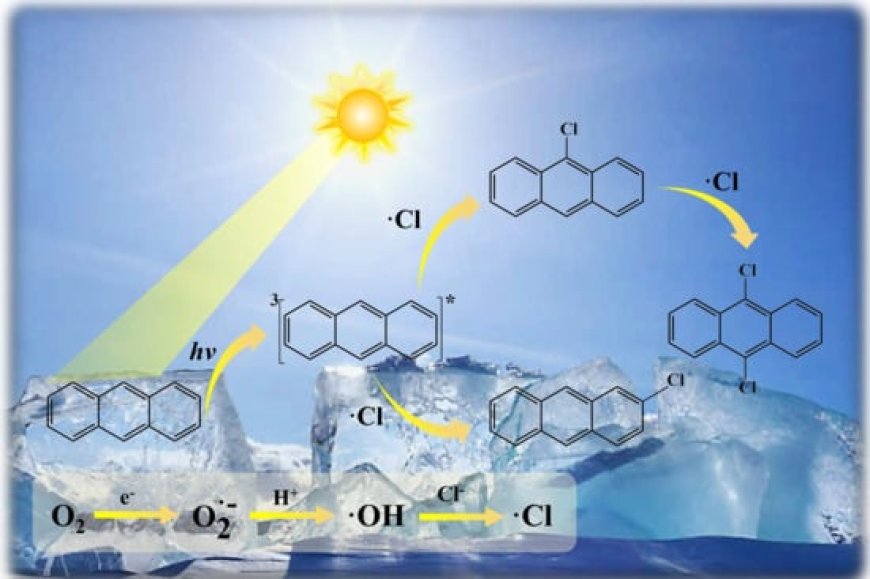
Polycyclic aromatic hydrocarbons (PAHs) can undergo photochemical reactions in chlorine-containing environments, generating chlorinated polycyclic aromatic hydrocarbons (ClPAHs). This phenomenon has been confirmed in aqueous and soil environments, while was previously overlooked in saline ice. Thus, this study aimed to investigate the photochemical chlorination behavior of anthracene (ANT) in saline ice. Under photoexcitation, the ground state ANT generates the singlet state ANT (1ANT*), which is transformed into the triplet state ANT (3ANT*) via intersystem crossing. Simultaneously, the oxygen receives electrons and further reacts to form the hydroxyl radical (·OH). The ·OH reacts with chloride ions (Cl−) to produce chlorine radicals (·Cl). The ·Cl then reacts with 3ANT* to form monochloroanthracene (9-ClANT, 2-ClANT). The resulting monochloroanthracene further reacts with ·Cl to form dichloroanthracene (9,10-Cl2ANT). Lower temperature, higher salinity, and dissolved organic matter are facilitated to generate ClPAHs, which may show negative impacts on the ecological environment.
Water, Vol. 16, Pages 1237: Photochlorination of Anthracene in Saline Ice under Simulated Solar Light
Water doi: 10.3390/w16091237
Authors: Yujie Li Xuefeng Hu Hao Xie Beichuan Cai Yaxing Bai
Polycyclic aromatic hydrocarbons (PAHs) can undergo photochemical reactions in chlorine-containing environments, generating chlorinated polycyclic aromatic hydrocarbons (ClPAHs). This phenomenon has been confirmed in aqueous and soil environments, while was previously overlooked in saline ice. Thus, this study aimed to investigate the photochemical chlorination behavior of anthracene (ANT) in saline ice. Under photoexcitation, the ground state ANT generates the singlet state ANT (1ANT*), which is transformed into the triplet state ANT (3ANT*) via intersystem crossing. Simultaneously, the oxygen receives electrons and further reacts to form the hydroxyl radical (·OH). The ·OH reacts with chloride ions (Cl−) to produce chlorine radicals (·Cl). The ·Cl then reacts with 3ANT* to form monochloroanthracene (9-ClANT, 2-ClANT). The resulting monochloroanthracene further reacts with ·Cl to form dichloroanthracene (9,10-Cl2ANT). Lower temperature, higher salinity, and dissolved organic matter are facilitated to generate ClPAHs, which may show negative impacts on the ecological environment.
What's Your Reaction?