Water, Vol. 16, Pages 1191: Added Biochars Promoted Nitrogen and Phosphorus Removal from Ecological Ditches at Low Temperature
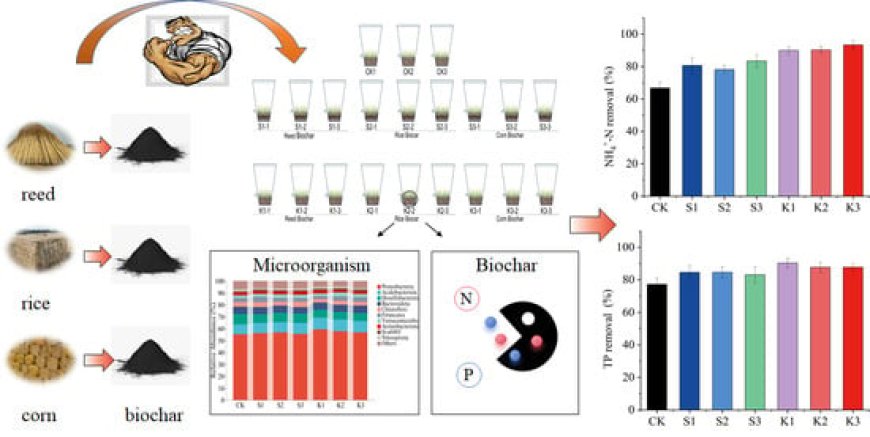
The global issue of ecological ditches being poor in removing nitrogen and phosphorus under cold winter temperatures has been identified. This study introduced three types of biochar (reed, rice, and corn) into ecological ditch sediments via two application methods: rhizosphere and mixed addition. The purpose was to explore how these methods affect the removal of nitrogen and phosphorus, as well as their influences on microbial communities in sediments. The results indicated that the addition of biochar to ecological ditches significantly enhanced the removal of nitrogen and phosphorus. Among the three types of biochar, the mixed addition of corn biochar yielded the greatest results, achieving removal rates of 77.1% for total nitrogen (TN), 93.3% for NH4+-N, and 90.3% for total phosphorus (TP). The growth of Vallisneria natans was greatly improved by the mixed addition method, resulting in an average increase of 154%. This improvement was superior to the rhizosphere addition group, which led to a growth increase of 125%. In comparison, the control group (CK) showed a decrease of 4.8% in growth. Different methods of biochar addition resulted in changes in the physicochemical properties and stoichiometry of the plants. Microbial analyses showed that the addition of biochar reduced the diversity and abundance of the substrate microbial community.
Water, Vol. 16, Pages 1191: Added Biochars Promoted Nitrogen and Phosphorus Removal from Ecological Ditches at Low Temperature
Water doi: 10.3390/w16081191
Authors: Guangsha Bai Si Pang Dongsu Bi Siqi Wang Min Cai Lingqi Kong Zheng Shen Yalei Zhang
The global issue of ecological ditches being poor in removing nitrogen and phosphorus under cold winter temperatures has been identified. This study introduced three types of biochar (reed, rice, and corn) into ecological ditch sediments via two application methods: rhizosphere and mixed addition. The purpose was to explore how these methods affect the removal of nitrogen and phosphorus, as well as their influences on microbial communities in sediments. The results indicated that the addition of biochar to ecological ditches significantly enhanced the removal of nitrogen and phosphorus. Among the three types of biochar, the mixed addition of corn biochar yielded the greatest results, achieving removal rates of 77.1% for total nitrogen (TN), 93.3% for NH4+-N, and 90.3% for total phosphorus (TP). The growth of Vallisneria natans was greatly improved by the mixed addition method, resulting in an average increase of 154%. This improvement was superior to the rhizosphere addition group, which led to a growth increase of 125%. In comparison, the control group (CK) showed a decrease of 4.8% in growth. Different methods of biochar addition resulted in changes in the physicochemical properties and stoichiometry of the plants. Microbial analyses showed that the addition of biochar reduced the diversity and abundance of the substrate microbial community.
What's Your Reaction?