Water, Vol. 16, Pages 1121: The Rhine Catchment: A Review of Sediment-Related Knowledge, Monitoring, and a Future Research Perspective
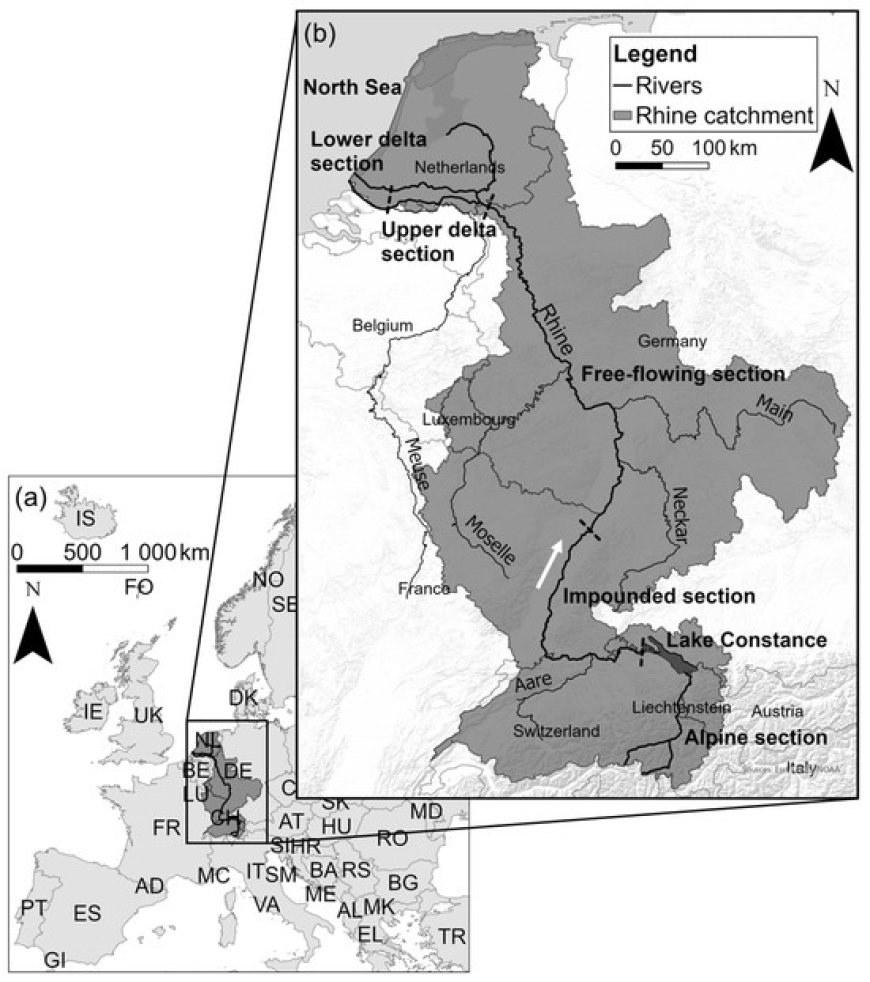
The Rhine River is affected by major human interventions affecting its morphology and sediment regime, which have severely changed its flow and sediment transport. While channelization has increased the sediment transport capacity in the free-flowing sections, the sediment retention behind dams has caused a bedload deficit downstream and has additionally intensified riverbed erosion. The resulting consequences range from the exposure of less erodible sediment layers that pose obstacles for navigation, to the scouring of infrastructure, the lowering of groundwater levels, and multiple negative ecological consequences. To optimize the efficiency of countermeasures, a coherent overview of all sediment-related activities and the state of knowledge on the Rhine catchment is required. That is why the present study aims to give a catchment-wide overview in this regard, identify knowledge gaps and proposing a future research programme. The methodological approach includes a comprehensive literature review and online interviews with experts from six riparian countries working in the fields of sediment research and management. Based on our investigations, we have derived several research topics, each consisting of research questions. Three project ideas were defined that should primarily be realized: (i) the influence of climate change and land use change on the sediment regime; (ii) alteration and improvement of the sediment balance and continuity, sediment transport, and morphology; and (iii) national and bilateral projects on sediment transport processes and management.
Water, Vol. 16, Pages 1121: The Rhine Catchment: A Review of Sediment-Related Knowledge, Monitoring, and a Future Research Perspective
Water doi: 10.3390/w16081121
Authors: Michael Krapesch Mario Klösch Wilfried ten Brinke Helmut Habersack
The Rhine River is affected by major human interventions affecting its morphology and sediment regime, which have severely changed its flow and sediment transport. While channelization has increased the sediment transport capacity in the free-flowing sections, the sediment retention behind dams has caused a bedload deficit downstream and has additionally intensified riverbed erosion. The resulting consequences range from the exposure of less erodible sediment layers that pose obstacles for navigation, to the scouring of infrastructure, the lowering of groundwater levels, and multiple negative ecological consequences. To optimize the efficiency of countermeasures, a coherent overview of all sediment-related activities and the state of knowledge on the Rhine catchment is required. That is why the present study aims to give a catchment-wide overview in this regard, identify knowledge gaps and proposing a future research programme. The methodological approach includes a comprehensive literature review and online interviews with experts from six riparian countries working in the fields of sediment research and management. Based on our investigations, we have derived several research topics, each consisting of research questions. Three project ideas were defined that should primarily be realized: (i) the influence of climate change and land use change on the sediment regime; (ii) alteration and improvement of the sediment balance and continuity, sediment transport, and morphology; and (iii) national and bilateral projects on sediment transport processes and management.
What's Your Reaction?