Water, Vol. 16, Pages 1192: Study on the Synergistic Effects of Karst Carbon Sink and Vegetation Carbon Sink in Watersheds under Different Geological Backgrounds—A Case Study of Darongjiang and Lingqu Watersheds
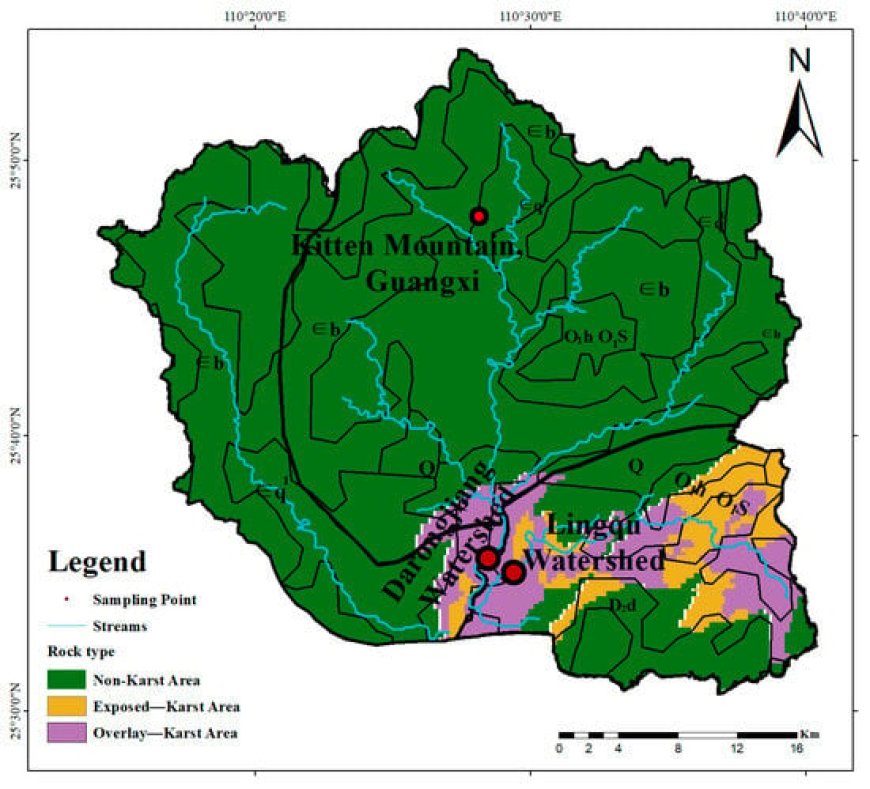
In this study, the hydrochemistry-runoff method and remote sensing estimation method were used to calculate the karst carbon sink flux (KCSF) and the forest vegetation carbon sequestration flux (FVCSF) in Darongjiang (DRJ) and Lingqu (LQ) watersheds. The results show the following: (1) The KCSF in DRJ and LQ watersheds is 238.43 × 10⁵ t·y−1 and 353.44 × 10⁵ t·y−1, respectively. Influenced by changes in flow rate, the two watersheds both show that their KCSF is higher in the rainy season than in the dry season. (2) The FVCSF in DRJ and LQ watersheds was 680.78 × 10⁷ t·y−1 and 229.63 × 10⁷ t·y−1, respectively. Through comparison, it can be seen that the FVCSF is much higher than the KCSF in both watersheds, but the FVCSF and the KCSF are at the same order of magnitude. (3) Through further analysis of the influence factors on the FVCSF and the KCSF, we found that the highest values of FVCSF are mainly distributed around Kitten Mountain on the upper reach and along the LQ watershed. That may be because most of the upper reach areas are mountainous forestland, and the strong weathering of rocks in the LQ watershed promotes the development of forest vegetation carbon sequestration. Therefore, it can be inferred that there is a certain synergistic effect between the karst carbon sink (KCS) and the forest vegetation carbon sequestration (FVCS) in the study area, and such a synergistic effect is caused by rock weathering.
Water, Vol. 16, Pages 1192: Study on the Synergistic Effects of Karst Carbon Sink and Vegetation Carbon Sink in Watersheds under Different Geological Backgrounds—A Case Study of Darongjiang and Lingqu Watersheds
Water doi: 10.3390/w16081192
Authors: Xue Wang Xiangling Tang Shi Yu Xuemei Zhong
In this study, the hydrochemistry-runoff method and remote sensing estimation method were used to calculate the karst carbon sink flux (KCSF) and the forest vegetation carbon sequestration flux (FVCSF) in Darongjiang (DRJ) and Lingqu (LQ) watersheds. The results show the following: (1) The KCSF in DRJ and LQ watersheds is 238.43 × 10⁵ t·y−1 and 353.44 × 10⁵ t·y−1, respectively. Influenced by changes in flow rate, the two watersheds both show that their KCSF is higher in the rainy season than in the dry season. (2) The FVCSF in DRJ and LQ watersheds was 680.78 × 10⁷ t·y−1 and 229.63 × 10⁷ t·y−1, respectively. Through comparison, it can be seen that the FVCSF is much higher than the KCSF in both watersheds, but the FVCSF and the KCSF are at the same order of magnitude. (3) Through further analysis of the influence factors on the FVCSF and the KCSF, we found that the highest values of FVCSF are mainly distributed around Kitten Mountain on the upper reach and along the LQ watershed. That may be because most of the upper reach areas are mountainous forestland, and the strong weathering of rocks in the LQ watershed promotes the development of forest vegetation carbon sequestration. Therefore, it can be inferred that there is a certain synergistic effect between the karst carbon sink (KCS) and the forest vegetation carbon sequestration (FVCS) in the study area, and such a synergistic effect is caused by rock weathering.
What's Your Reaction?