Water, Vol. 16, Pages 1137: Geochemical Assessment of the Evolution of Groundwater under the Impact of Seawater Intrusion in the Mannar District of Sri Lanka
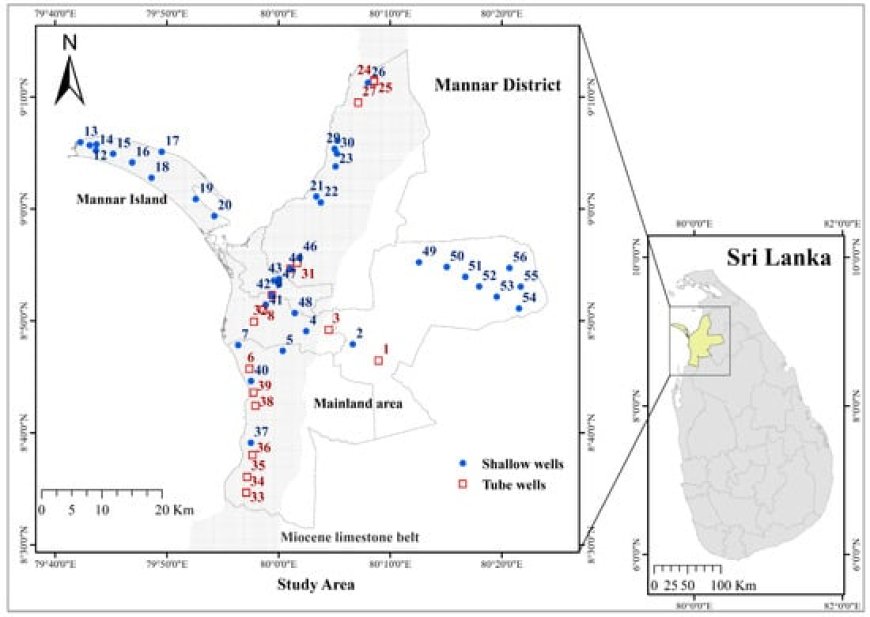
Groundwater is an important drinking water resource in the coastal regions of island countries and has suffered from heavy seawater intrusion. However, the areas specifically affected by seawater intrusion and their groundwater hydrogeochemical compositions and evolution processes remain unclear. This study analyzed the hydrogeochemical compositions, water quality, and evolution processes of groundwater in the Mannar district, Sri Lanka, during the dry season. A total of 56 samples were collected from shallow wells and tube wells across the region, and about 64.28% of groundwater samples had good quality (WQI < 100). Geochemical compositions and water quality parameters had a high level in the north and south mainland regions, where they severely suffered from seawater intrusion with a high content of Cl− and Na+. The geochemical compositions of groundwater in the Mannar district were predominantly affected by rock weathering and/or evaporation processes. Cl-Na and HCO3-Ca facies were the main hydrochemical types, and the corresponding ions were mainly from silicate and halite dissolution. The reverse cation exchange process mainly occurred in seawater intrusion areas. The study highlights the impacts of seawater intrusion on the hydrogeochemical compositions and evolution processes in Mannar region groundwater, which will enhance the understanding of the local water quality and seawater intrusion situation and aid in protecting drinking water safety by routinely monitoring the groundwater quality and implementing targeted desalination techniques in the key areas.
Water, Vol. 16, Pages 1137: Geochemical Assessment of the Evolution of Groundwater under the Impact of Seawater Intrusion in the Mannar District of Sri Lanka
Water doi: 10.3390/w16081137
Authors: Samadhi Athauda Yunwen Wang Zhineng Hao Suresh Indika Isuru Yapabandara Sujithra K. Weragoda Jingfu Liu Yuansong Wei
Groundwater is an important drinking water resource in the coastal regions of island countries and has suffered from heavy seawater intrusion. However, the areas specifically affected by seawater intrusion and their groundwater hydrogeochemical compositions and evolution processes remain unclear. This study analyzed the hydrogeochemical compositions, water quality, and evolution processes of groundwater in the Mannar district, Sri Lanka, during the dry season. A total of 56 samples were collected from shallow wells and tube wells across the region, and about 64.28% of groundwater samples had good quality (WQI < 100). Geochemical compositions and water quality parameters had a high level in the north and south mainland regions, where they severely suffered from seawater intrusion with a high content of Cl− and Na+. The geochemical compositions of groundwater in the Mannar district were predominantly affected by rock weathering and/or evaporation processes. Cl-Na and HCO3-Ca facies were the main hydrochemical types, and the corresponding ions were mainly from silicate and halite dissolution. The reverse cation exchange process mainly occurred in seawater intrusion areas. The study highlights the impacts of seawater intrusion on the hydrogeochemical compositions and evolution processes in Mannar region groundwater, which will enhance the understanding of the local water quality and seawater intrusion situation and aid in protecting drinking water safety by routinely monitoring the groundwater quality and implementing targeted desalination techniques in the key areas.
What's Your Reaction?