Water, Vol. 16, Pages 1138: Impact of Future Climate Scenarios and Bias Correction Methods on the Achibueno River Basin
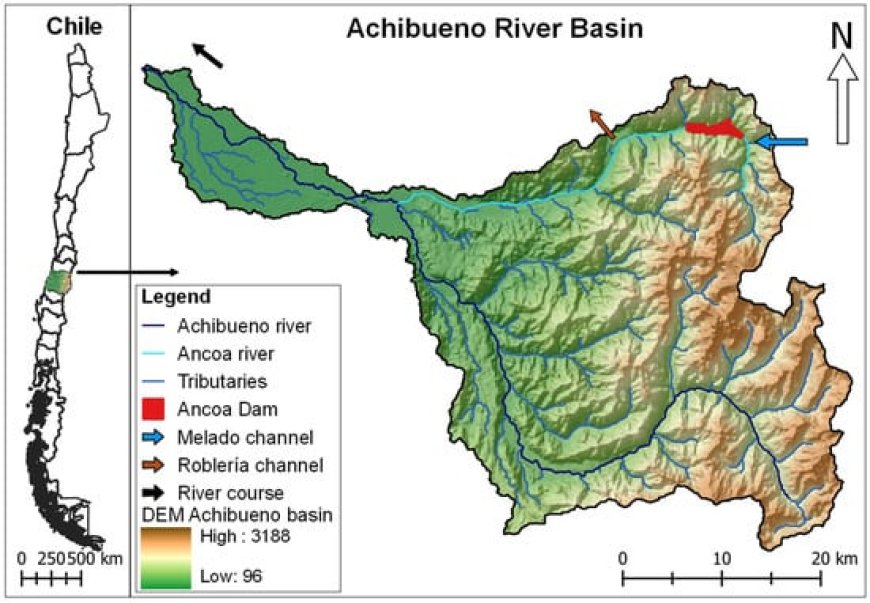
Future climate scenarios based on regional climate models (RCMs) have been evaluated widely. However, the use of RCMs without bias correction may increase the uncertainty in the assessment of climate change impacts, especially in mountain areas. Five quantile mapping methods (QMMs) were evaluated as bias correction methods for precipitation and temperature in the historical period (1979–2005) of one local climate model and three RCMs at the Achibueno River Basin, southcentral Chile. Additionally, bias-corrected climate scenarios from 2025 to 2050 under two Representative Concentration Pathways (RCPs) were evaluated on the hydrological response of the catchment with the Soil and Water Assessment Tool (SWAT+). The parametric transformation function and robust empirical quantile were the most promising bias correction methods for precipitation and temperature, respectively. Climate scenarios suggest changes in the frequency and amount of precipitation with fluctuations in temperatures. Under RCP 2.6, partial increases in precipitation, water yield, and evapotranspiration are projected, while for RCP 8.5, strong peaks of precipitation and water yield in short periods of time, together with increases in evapotranspiration, are expected. Consequently, flooding events and increasing irrigation demand are changes likely to take place. Therefore, considering adaptation of current and future management practices for the protection of water resources in southcentral Chile is mandatory.
Water, Vol. 16, Pages 1138: Impact of Future Climate Scenarios and Bias Correction Methods on the Achibueno River Basin
Water doi: 10.3390/w16081138
Authors: Héctor Moya Ingrid Althoff Juan L. Celis-Diez Carlos Huenchuleo-Pedreros Paolo Reggiani
Future climate scenarios based on regional climate models (RCMs) have been evaluated widely. However, the use of RCMs without bias correction may increase the uncertainty in the assessment of climate change impacts, especially in mountain areas. Five quantile mapping methods (QMMs) were evaluated as bias correction methods for precipitation and temperature in the historical period (1979–2005) of one local climate model and three RCMs at the Achibueno River Basin, southcentral Chile. Additionally, bias-corrected climate scenarios from 2025 to 2050 under two Representative Concentration Pathways (RCPs) were evaluated on the hydrological response of the catchment with the Soil and Water Assessment Tool (SWAT+). The parametric transformation function and robust empirical quantile were the most promising bias correction methods for precipitation and temperature, respectively. Climate scenarios suggest changes in the frequency and amount of precipitation with fluctuations in temperatures. Under RCP 2.6, partial increases in precipitation, water yield, and evapotranspiration are projected, while for RCP 8.5, strong peaks of precipitation and water yield in short periods of time, together with increases in evapotranspiration, are expected. Consequently, flooding events and increasing irrigation demand are changes likely to take place. Therefore, considering adaptation of current and future management practices for the protection of water resources in southcentral Chile is mandatory.
What's Your Reaction?