Water, Vol. 16, Pages 1107: The Influence of Aqueous Iron on River Sand’s Arsenic Adsorption: Characteristics and Mechanisms
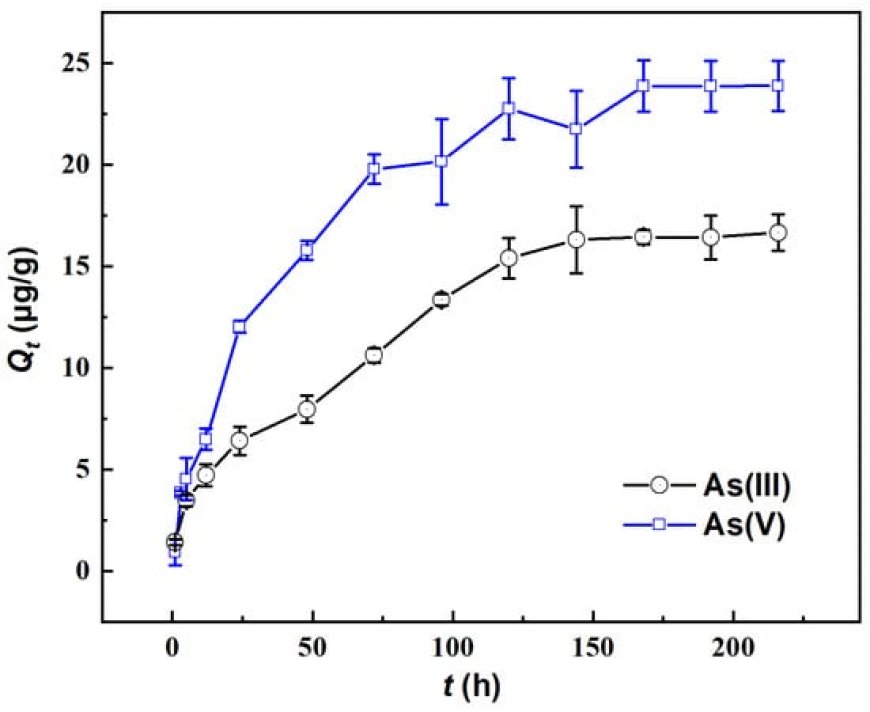
Iron-containing minerals are key factors controlling arsenic (As) transport in groundwater environments. However, few studies have observed the effect of aqueous Fe [Fe(aq)] on As behavior in a water environment. In this study, river sand in the riparian zone was collected for batch experiments to analyze the effect of Fe(aq) on the adsorption of As on river sand, utilizing characterization analyses to identify the reaction mechanism. The results showed that (1) as the concentration of Fe(aq) in the reaction system increased from 0.1 to 20 mg/L, the equilibrium adsorption capacity (Qe) of river sand for As(III) and As(V) gradually increased. For concentrations of Fe(aq) equal to or greater than 1 mg/L, the Qe for As(V) exceeds that for As(III), whereas at a Fe(aq) concentration of 0.1 mg/L, the Qe for As(III) is higher than that for As(V). (2) Compared to the reaction system without added Fe(aq), the adsorption of As(V) onto river sand was inhibited, while the adsorption of As(III) was enhanced under conditions with low concentrations (0.1, 1 mg/L) of Fe(aq). (3) At higher Fe(aq) concentrations (5, 20 mg/L), the adsorption of both As(V) and As(III) by river sand was more effective than in systems without Fe(aq). Characterization tests confirmed this, while Fe(II) reduced As(V), and Fe(aq) adhered to the surface of river sand to form Fe(OH)3 colloids, thereby facilitating the adsorption of As onto river sand.
Water, Vol. 16, Pages 1107: The Influence of Aqueous Iron on River Sand’s Arsenic Adsorption: Characteristics and Mechanisms
Water doi: 10.3390/w16081107
Authors: Zheying Li Sanxi Peng Huimei Shan Qian Liao Hai Zhou Zhicheng Zhao
Iron-containing minerals are key factors controlling arsenic (As) transport in groundwater environments. However, few studies have observed the effect of aqueous Fe [Fe(aq)] on As behavior in a water environment. In this study, river sand in the riparian zone was collected for batch experiments to analyze the effect of Fe(aq) on the adsorption of As on river sand, utilizing characterization analyses to identify the reaction mechanism. The results showed that (1) as the concentration of Fe(aq) in the reaction system increased from 0.1 to 20 mg/L, the equilibrium adsorption capacity (Qe) of river sand for As(III) and As(V) gradually increased. For concentrations of Fe(aq) equal to or greater than 1 mg/L, the Qe for As(V) exceeds that for As(III), whereas at a Fe(aq) concentration of 0.1 mg/L, the Qe for As(III) is higher than that for As(V). (2) Compared to the reaction system without added Fe(aq), the adsorption of As(V) onto river sand was inhibited, while the adsorption of As(III) was enhanced under conditions with low concentrations (0.1, 1 mg/L) of Fe(aq). (3) At higher Fe(aq) concentrations (5, 20 mg/L), the adsorption of both As(V) and As(III) by river sand was more effective than in systems without Fe(aq). Characterization tests confirmed this, while Fe(II) reduced As(V), and Fe(aq) adhered to the surface of river sand to form Fe(OH)3 colloids, thereby facilitating the adsorption of As onto river sand.
What's Your Reaction?