IJERPH, Vol. 21, Pages 576: Landscape and Socioeconomic Factors Determine Malaria Incidence in Tropical Forest Countries
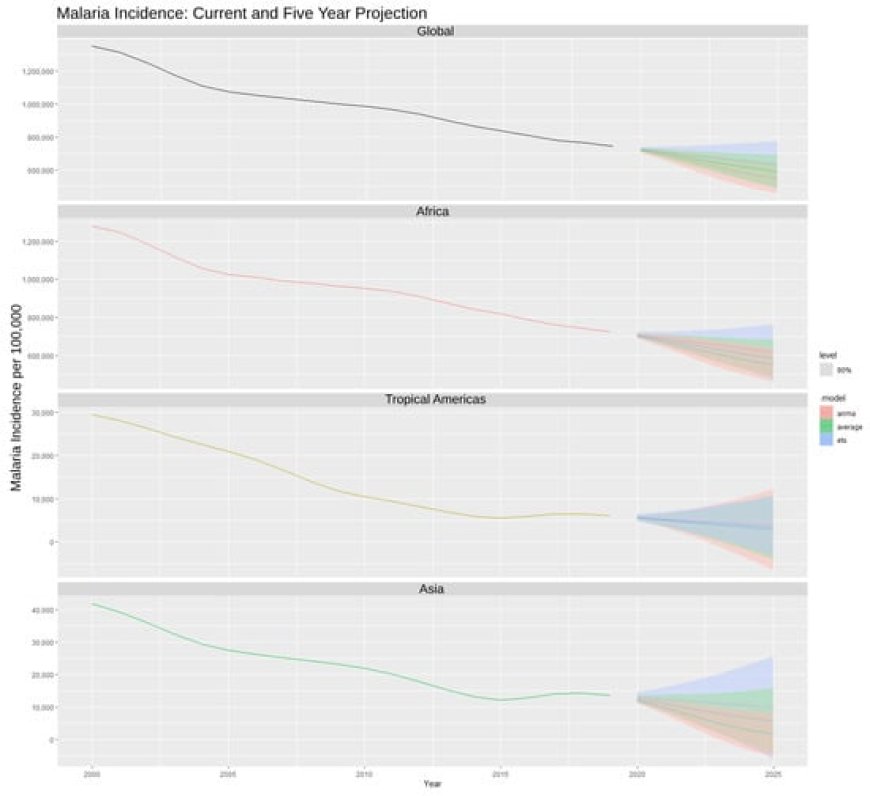
Deforestation, landscape dynamics, and socioeconomic factors within the tropical Americas, Africa, and Asia may have different impacts on malaria incidence. To evaluate how these drivers affect malaria incidence at the global and regional scale, we collected malaria incidence rates from 2000 to 2019 from 67 tropical countries, along with forest loss, land use change types, and socioeconomic elements. LASSO regression, linear mixed effect modeling, and k-fold cross validation were used to create and evaluate the models. Regionality plays a role in the significance of varying risk factors. The Tropical Americas model had the highest coefficient of determination (marginal R2 = 0.369), while the Africa model showed the highest predictive accuracy with only a 17.4% error rate. Strong associations between tree cover loss (β = −4037.73, p < 0.001) and percentage forest area (β = 5373.18, p = 0.012) in Africa, and percent of key biodiversity areas under protection (β = 496.71, p < 0.001; β = 1679.20, p < 0.001) in the tropical Americas and Asia with malaria incidence indicates that malaria risk should be considered during conservation policy development, and recommends that individual approaches to policy and investment be considered when implementing malaria interventions on different spatial scales.
IJERPH, Vol. 21, Pages 576: Landscape and Socioeconomic Factors Determine Malaria Incidence in Tropical Forest Countries
International Journal of Environmental Research and Public Health doi: 10.3390/ijerph21050576
Authors: Allison Bailey Paula R. Prist
Deforestation, landscape dynamics, and socioeconomic factors within the tropical Americas, Africa, and Asia may have different impacts on malaria incidence. To evaluate how these drivers affect malaria incidence at the global and regional scale, we collected malaria incidence rates from 2000 to 2019 from 67 tropical countries, along with forest loss, land use change types, and socioeconomic elements. LASSO regression, linear mixed effect modeling, and k-fold cross validation were used to create and evaluate the models. Regionality plays a role in the significance of varying risk factors. The Tropical Americas model had the highest coefficient of determination (marginal R2 = 0.369), while the Africa model showed the highest predictive accuracy with only a 17.4% error rate. Strong associations between tree cover loss (β = −4037.73, p < 0.001) and percentage forest area (β = 5373.18, p = 0.012) in Africa, and percent of key biodiversity areas under protection (β = 496.71, p < 0.001; β = 1679.20, p < 0.001) in the tropical Americas and Asia with malaria incidence indicates that malaria risk should be considered during conservation policy development, and recommends that individual approaches to policy and investment be considered when implementing malaria interventions on different spatial scales.
What's Your Reaction?