IJERPH, Vol. 21, Pages 512: Understanding the Risk of Social Vulnerability for the Chinese Diaspora during the COVID-19 Pandemic: A Model Driving Risk Perception and Threat Appraisal of Risk Communication—A Qualitative Study
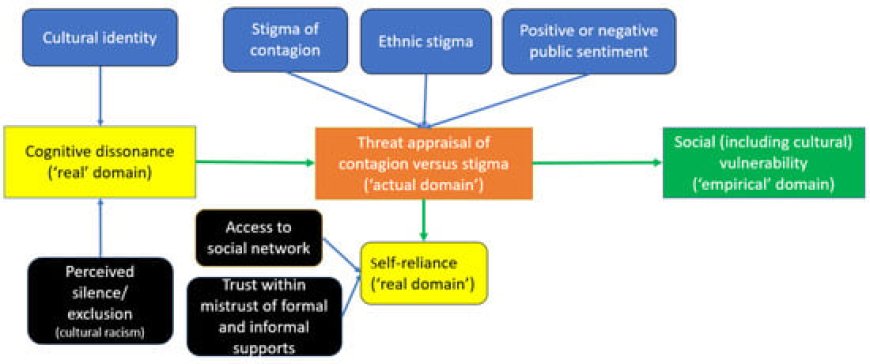
During the first wave of the COVID-19 pandemic, immigrants were among the most socially vulnerable in Western countries. The Chinese diaspora in Canada were one such group due to the widespread cultural stigma surrounding their purported greater susceptibility to transmit and become infected by COVID-19. This paper aims to understand the social vulnerability of the Chinese diaspora in the Greater Toronto Area, Canada, during the first wave of COVID-19 from an explanation of their risk perception and threat appraisal of risk communication. We conducted secondary data analysis of 36 interviews using critical realism. The participants self-identified as being of Chinese descent. The results were used to develop a model of how social vulnerability occurred. In brief, cognitive dissonance was discovered to generate conflicts of one’s cultural identity, shaped by social structures of (i) stigma of contagion, (ii) ethnic stigma, and (iii) public sentiment, and mediated by participants’ threat appraisal and (iv) self-reliance. We assert that risk communicators need to consider their audiences’ diverse socialization in crafting messages to modify behaviors, create a sense of responsibility, and mitigate public health threats. A lack of awareness of one’s cognitive dissonance driven by cultural vulnerability may heighten their social vulnerability and prevent them from taking action to protect themself from high-risk events.
IJERPH, Vol. 21, Pages 512: Understanding the Risk of Social Vulnerability for the Chinese Diaspora during the COVID-19 Pandemic: A Model Driving Risk Perception and Threat Appraisal of Risk Communication—A Qualitative Study
International Journal of Environmental Research and Public Health doi: 10.3390/ijerph21040512
Authors: Doris Yuet Lan Leung Hilary Hwu Shoilee Khan Aaida Mamuji Jack Rozdilsky Terri Chu Charlotte Lee
During the first wave of the COVID-19 pandemic, immigrants were among the most socially vulnerable in Western countries. The Chinese diaspora in Canada were one such group due to the widespread cultural stigma surrounding their purported greater susceptibility to transmit and become infected by COVID-19. This paper aims to understand the social vulnerability of the Chinese diaspora in the Greater Toronto Area, Canada, during the first wave of COVID-19 from an explanation of their risk perception and threat appraisal of risk communication. We conducted secondary data analysis of 36 interviews using critical realism. The participants self-identified as being of Chinese descent. The results were used to develop a model of how social vulnerability occurred. In brief, cognitive dissonance was discovered to generate conflicts of one’s cultural identity, shaped by social structures of (i) stigma of contagion, (ii) ethnic stigma, and (iii) public sentiment, and mediated by participants’ threat appraisal and (iv) self-reliance. We assert that risk communicators need to consider their audiences’ diverse socialization in crafting messages to modify behaviors, create a sense of responsibility, and mitigate public health threats. A lack of awareness of one’s cognitive dissonance driven by cultural vulnerability may heighten their social vulnerability and prevent them from taking action to protect themself from high-risk events.
What's Your Reaction?