Climate, Vol. 12, Pages 44: Safe Sowing Windows for Smallholder Farmers in West Africa in the Context of Climate Variability
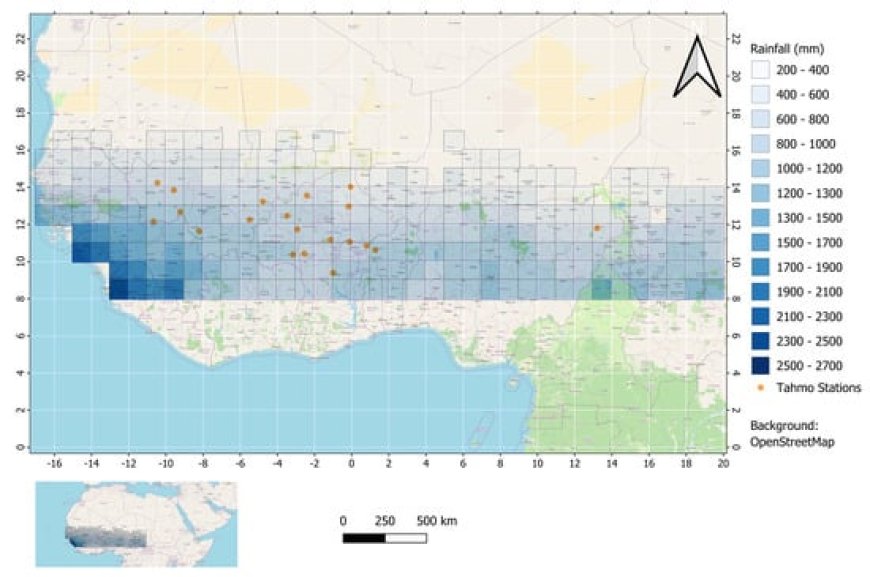
Climate variability poses great challenges to food security in West Africa, a region heavily dependent on rainfall for farming. Identifying sowing strategies that minimize yield losses for farmers in the region is crucial to securing their livelihood. In this paper, we investigate three sowing strategies to assess their ability to identify safe sowing windows for smallholder farmers in the Sudanian region of West Africa (WA) in the context of a changing climate. The GIS version of the FAO crop model, AquaCrop-GIS, is used to simulate the yield response of maize (Zea mays L.) to varying sowing dates throughout the rainy season across WA. Based on an average of 38 years of data per grid cell, we identify safe sowing windows across the Sudanian region that secure at least 90% of maximal yield. We find that current sowing strategies, based on minimum thresholds for rainfall accumulated over a period that are widely applied in the region, carry a higher risk of yield failure, especially at the beginning of the rainy season. This analysis shows that delaying sowing for a month to mid-June in the central region (east of Lon 8.5°W), and to early August in the semi-arid areas is a safer strategy that ensures optimal yields. A comparison between the periods 1982–1991 and 1992–2019 shows a negative shift for LO10 mm and LO20 mm, suggesting a wetter regime compared to the dry periods of the 1970s and 1980s. On the contrary, we observe a positive shift in the safe window strategy, highlighting the need for precautions due to erratic rainfall at the beginning of the season. The precipitation-based strategies hold a high risk, while the safe sowing window strategy, easily accessible to smallholder farmers, is more fitting, given the current climate.
Climate, Vol. 12, Pages 44: Safe Sowing Windows for Smallholder Farmers in West Africa in the Context of Climate Variability
Climate doi: 10.3390/cli12030044
Authors: Sehouevi Mawuton David Agoungbome Marie-Claire ten Veldhuis Nick van de Giesen
Climate variability poses great challenges to food security in West Africa, a region heavily dependent on rainfall for farming. Identifying sowing strategies that minimize yield losses for farmers in the region is crucial to securing their livelihood. In this paper, we investigate three sowing strategies to assess their ability to identify safe sowing windows for smallholder farmers in the Sudanian region of West Africa (WA) in the context of a changing climate. The GIS version of the FAO crop model, AquaCrop-GIS, is used to simulate the yield response of maize (Zea mays L.) to varying sowing dates throughout the rainy season across WA. Based on an average of 38 years of data per grid cell, we identify safe sowing windows across the Sudanian region that secure at least 90% of maximal yield. We find that current sowing strategies, based on minimum thresholds for rainfall accumulated over a period that are widely applied in the region, carry a higher risk of yield failure, especially at the beginning of the rainy season. This analysis shows that delaying sowing for a month to mid-June in the central region (east of Lon 8.5°W), and to early August in the semi-arid areas is a safer strategy that ensures optimal yields. A comparison between the periods 1982–1991 and 1992–2019 shows a negative shift for LO10 mm and LO20 mm, suggesting a wetter regime compared to the dry periods of the 1970s and 1980s. On the contrary, we observe a positive shift in the safe window strategy, highlighting the need for precautions due to erratic rainfall at the beginning of the season. The precipitation-based strategies hold a high risk, while the safe sowing window strategy, easily accessible to smallholder farmers, is more fitting, given the current climate.
What's Your Reaction?