Hydrology, Vol. 11, Pages 5: Agricultural Water Footprints and Productivity in the Colorado River Basin
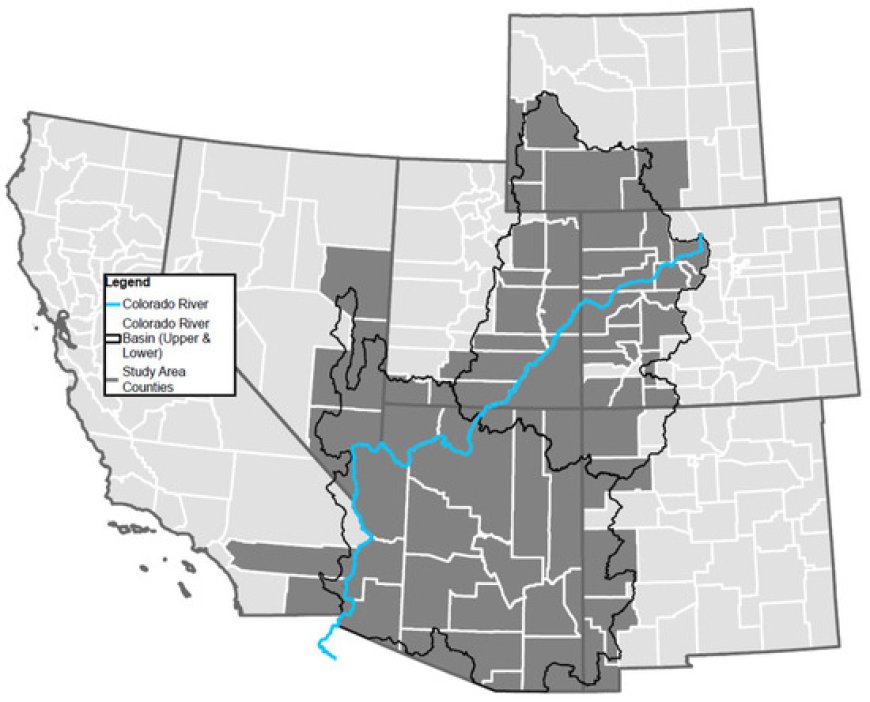
The Colorado River provides water to 40 million people in the U.S. Southwest, with river basin spanning 250,000 square miles (647,497 km2). Quantitative water rights assigned to U.S. states, Mexico, and tribes in the Colorado Basin exceed annual streamflows. Climate change is expected to limit streamflows further. To balance water demands with supplies, unprecedented water-use cutbacks have been proposed, primarily for agriculture, which consumes more than 60% of the Basin’s water. This study develops county-level, Basin-wide measures of agricultural economic water productivity, water footprints, and irrigation cash rent premiums, to inform conservation programs and compensation schemes. These measures identify areas where conservation costs in terms of foregone crop production or farm income are high or low. Crop sales averaged USD 814 per acre foot (AF) (USD 0.66/m3) of water consumed in the Lower Basin and 131 USD/AF (USD 0.11/m3) in the Upper Basin. Crop sales minus crop-specific input costs averaged 485 USD/AF (USD 0.39/m3) in the Lower Basin and 93 USD/AF (USD 0.08 per m3) in the Upper Basin. The blue water footprint (BWF) was 1.2 AF/USD 1K (1480 m3/USD1K) of water per thousand dollars of crop sales in the Lower Basin and 7.6 AF/USD 1K (9374 m3/USD1K) in the Upper Basin. Counties with higher water consumption per acre have a lower BWF.
Hydrology, Vol. 11, Pages 5: Agricultural Water Footprints and Productivity in the Colorado River Basin
Hydrology doi: 10.3390/hydrology11010005
Authors: George B. Frisvold Dari Duval
The Colorado River provides water to 40 million people in the U.S. Southwest, with river basin spanning 250,000 square miles (647,497 km2). Quantitative water rights assigned to U.S. states, Mexico, and tribes in the Colorado Basin exceed annual streamflows. Climate change is expected to limit streamflows further. To balance water demands with supplies, unprecedented water-use cutbacks have been proposed, primarily for agriculture, which consumes more than 60% of the Basin’s water. This study develops county-level, Basin-wide measures of agricultural economic water productivity, water footprints, and irrigation cash rent premiums, to inform conservation programs and compensation schemes. These measures identify areas where conservation costs in terms of foregone crop production or farm income are high or low. Crop sales averaged USD 814 per acre foot (AF) (USD 0.66/m3) of water consumed in the Lower Basin and 131 USD/AF (USD 0.11/m3) in the Upper Basin. Crop sales minus crop-specific input costs averaged 485 USD/AF (USD 0.39/m3) in the Lower Basin and 93 USD/AF (USD 0.08 per m3) in the Upper Basin. The blue water footprint (BWF) was 1.2 AF/USD 1K (1480 m3/USD1K) of water per thousand dollars of crop sales in the Lower Basin and 7.6 AF/USD 1K (9374 m3/USD1K) in the Upper Basin. Counties with higher water consumption per acre have a lower BWF.
What's Your Reaction?