Hydrology, Vol. 11, Pages 10: ARIMA and TFARIMA Analysis of the Main Water Quality Parameters in the Initial Components of a Megacity’s Drinking Water Supply System
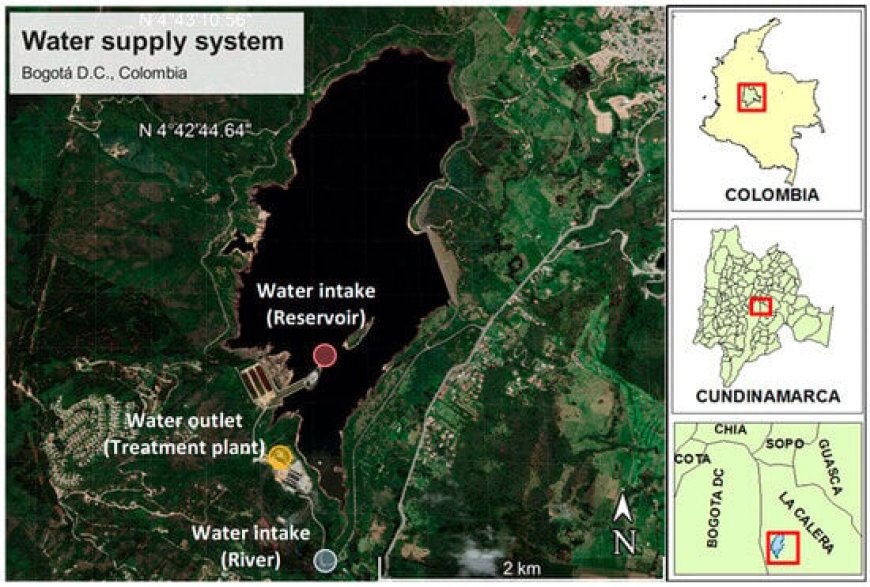
The objective of this paper is to use autoregressive, integrated, and moving average (ARIMA) and transfer function ARIMA (TFARIMA) models to analyze the behavior of the main water quality parameters in the initial components of a drinking water supply system (DWSS) of a megacity (Bogota, Colombia). The DWSS considered in this study consisted of the following components: a river, a reservoir, and a drinking water treatment plant (WTP). Water quality information was collected daily and over a period of 8 years. A comparative analysis was made between the components of the DWSS based on the structure of the ARIMA and TFARIMA models developed. The results show that the best water quality indicators are the following: turbidity > color > total iron. Increasing the time window of the ARIMA analysis (daily/weekly/monthly) suggests an increase in the magnitude of the AR term for each DWSS component (WTP > river > reservoir). This trend suggests that the turbidity behavior in the WTP is more influenced by past observations compared to the turbidity behavior in the river and reservoir, respectively. Smoothing of the data series (moving average) as the time window of the ARIMA analysis increases leads to a greater sensitivity of the model for outlier detection. TFARIMA models suggest that there is no significant influence of past river turbidity events on turbidity in the reservoir, and of reservoir turbidity on turbidity at the WTP outlet. Turbidity outlier events between the river and reservoir occur mainly in a single observation (additive outliers), and between the reservoir and WTP also have a permanent effect over time (level shift outliers). The AR term of the models is useful for studying the transfer of effects between DWSS components, and the MA term is useful for studying the influence of external factors on water quality in each DWSS component.
Hydrology, Vol. 11, Pages 10: ARIMA and TFARIMA Analysis of the Main Water Quality Parameters in the Initial Components of a Megacity’s Drinking Water Supply System
Hydrology doi: 10.3390/hydrology11010010
Authors: Carlos Alfonso Zafra-Mejía Hugo Alexander Rondón-Quintana Carlos Felipe Urazán-Bonells
The objective of this paper is to use autoregressive, integrated, and moving average (ARIMA) and transfer function ARIMA (TFARIMA) models to analyze the behavior of the main water quality parameters in the initial components of a drinking water supply system (DWSS) of a megacity (Bogota, Colombia). The DWSS considered in this study consisted of the following components: a river, a reservoir, and a drinking water treatment plant (WTP). Water quality information was collected daily and over a period of 8 years. A comparative analysis was made between the components of the DWSS based on the structure of the ARIMA and TFARIMA models developed. The results show that the best water quality indicators are the following: turbidity > color > total iron. Increasing the time window of the ARIMA analysis (daily/weekly/monthly) suggests an increase in the magnitude of the AR term for each DWSS component (WTP > river > reservoir). This trend suggests that the turbidity behavior in the WTP is more influenced by past observations compared to the turbidity behavior in the river and reservoir, respectively. Smoothing of the data series (moving average) as the time window of the ARIMA analysis increases leads to a greater sensitivity of the model for outlier detection. TFARIMA models suggest that there is no significant influence of past river turbidity events on turbidity in the reservoir, and of reservoir turbidity on turbidity at the WTP outlet. Turbidity outlier events between the river and reservoir occur mainly in a single observation (additive outliers), and between the reservoir and WTP also have a permanent effect over time (level shift outliers). The AR term of the models is useful for studying the transfer of effects between DWSS components, and the MA term is useful for studying the influence of external factors on water quality in each DWSS component.
What's Your Reaction?