Hydrology, Vol. 11, Pages 11: Microplastic Contamination of Fine-Grained Sediments and Its Environmental Driving Factors along a Lowland River: Three-Year Monitoring of the Tisza River and Central Europe
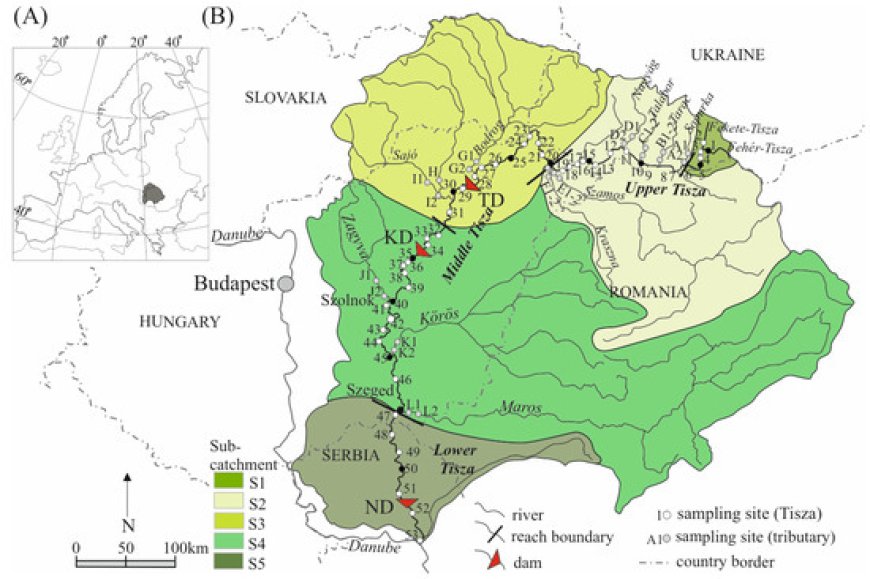
The hydro-geomorphological background in microplastic (MP) deposition and mobilization is often neglected, though the sampling environment is the key point in a monitoring scheme. The aim of the study was to analyze the environmental driving factors of MP transport over three years (2020–2022) along a 750 km-long section of the Tisza River, Central Europe. The mean MP content of the fresh clayey sediments was 1291 ± 618 items/kg in 2020, and then it decreased (2021: 730 ± 568 items/kg; 2022: 766 ± 437 items/kg). The upstream and downstream sections were the most polluted due to improper local sewage treatment. In 2020, 63% of the sites were hotspot (≥2000 items/kg), but their number decreased to one-third in 2021 and 2022. MP pollution is influenced by highly variable environmental factors. (1) The geomorphological setting of a site is important, as most of the hotspots are on side bars. (2) The tributaries convey MP pollution to the Tisza River. (3) The bankfull or higher flood waves effectively rearrange the MP pollution. (4) The dams and their operation influence the downstream trend of MP pollution in the reservoir. (5) Downstream of a dam, the clear-water erosion increases the proportion of the pristine sediments; thus, the MP concentration decreases.
Hydrology, Vol. 11, Pages 11: Microplastic Contamination of Fine-Grained Sediments and Its Environmental Driving Factors along a Lowland River: Three-Year Monitoring of the Tisza River and Central Europe
Hydrology doi: 10.3390/hydrology11010011
Authors: Alexia Balla Vesna Teofilovic Tímea Kiss
The hydro-geomorphological background in microplastic (MP) deposition and mobilization is often neglected, though the sampling environment is the key point in a monitoring scheme. The aim of the study was to analyze the environmental driving factors of MP transport over three years (2020–2022) along a 750 km-long section of the Tisza River, Central Europe. The mean MP content of the fresh clayey sediments was 1291 ± 618 items/kg in 2020, and then it decreased (2021: 730 ± 568 items/kg; 2022: 766 ± 437 items/kg). The upstream and downstream sections were the most polluted due to improper local sewage treatment. In 2020, 63% of the sites were hotspot (≥2000 items/kg), but their number decreased to one-third in 2021 and 2022. MP pollution is influenced by highly variable environmental factors. (1) The geomorphological setting of a site is important, as most of the hotspots are on side bars. (2) The tributaries convey MP pollution to the Tisza River. (3) The bankfull or higher flood waves effectively rearrange the MP pollution. (4) The dams and their operation influence the downstream trend of MP pollution in the reservoir. (5) Downstream of a dam, the clear-water erosion increases the proportion of the pristine sediments; thus, the MP concentration decreases.
What's Your Reaction?