Environments, Vol. 11, Pages 77: Heavy Metal Accumulation in Three Varieties of Mustard Grown under Five Soil Management Practices
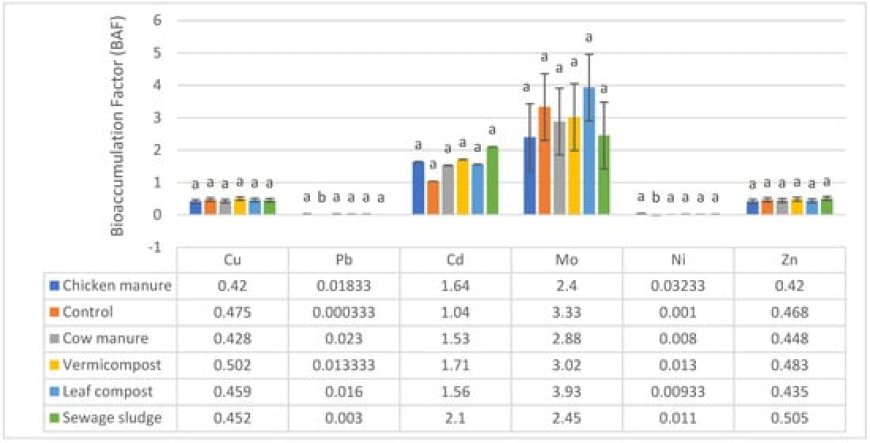
Heavy metal pollution represents a global health issue. Different methods and technologies are adopted to mitigate the problem of heavy metal pollution. Phytoremediation has been gaining attention as an environmentally friendly method to remediate this problem. The purpose of this research is to explore the effectiveness of phytoremediation in agricultural settings to assess the effect of five soil management practices (chicken manure, sewage sludge, leaf compost, cow manure, and vermicompost) on Cd, Cu, Mo, Ni, Pb, and Zn accumulation in the mustard (leaves and pods) of three mustard Brassica juncea varieties (black mustard, yellow mustard, and mighty mustard). The accumulation in mustard was quantified using the Inductively Coupled Plasma Optical Emission Spectrometer (ICP-OES). The results showed that the bioaccumulation factor (BAF) of the three mustard varieties exceeded one (BAF > 1) for Cd and Mo. It indicates that mustard is a good accumulator of Cd and Mo, whereas BAF values for Cu, Pb, Ni, and Zn were less than one (BAF < 1). The accumulated Cu, Mo, Ni, and Zn levels were below the allowable limit, whereas the Cd and Pb levels were beyond the limit. This result indicates that the investigated mustard varieties can be grown on heavy metal polluted sites for Cd and Mo phytoremediation purposes, but care is needed with regard to Cd and Mo toxicity.
Environments, Vol. 11, Pages 77: Heavy Metal Accumulation in Three Varieties of Mustard Grown under Five Soil Management Practices
Environments doi: 10.3390/environments11040077
Authors: Anjan Nepal George F. Antonious Frederick N. Bebe Thomas C. Webster Buddhi R. Gyawali Basanta Neupane
Heavy metal pollution represents a global health issue. Different methods and technologies are adopted to mitigate the problem of heavy metal pollution. Phytoremediation has been gaining attention as an environmentally friendly method to remediate this problem. The purpose of this research is to explore the effectiveness of phytoremediation in agricultural settings to assess the effect of five soil management practices (chicken manure, sewage sludge, leaf compost, cow manure, and vermicompost) on Cd, Cu, Mo, Ni, Pb, and Zn accumulation in the mustard (leaves and pods) of three mustard Brassica juncea varieties (black mustard, yellow mustard, and mighty mustard). The accumulation in mustard was quantified using the Inductively Coupled Plasma Optical Emission Spectrometer (ICP-OES). The results showed that the bioaccumulation factor (BAF) of the three mustard varieties exceeded one (BAF > 1) for Cd and Mo. It indicates that mustard is a good accumulator of Cd and Mo, whereas BAF values for Cu, Pb, Ni, and Zn were less than one (BAF < 1). The accumulated Cu, Mo, Ni, and Zn levels were below the allowable limit, whereas the Cd and Pb levels were beyond the limit. This result indicates that the investigated mustard varieties can be grown on heavy metal polluted sites for Cd and Mo phytoremediation purposes, but care is needed with regard to Cd and Mo toxicity.
What's Your Reaction?