Climate, Vol. 12, Pages 12: Development of Inherent Vulnerability Index within Jammu Municipal Limits, India
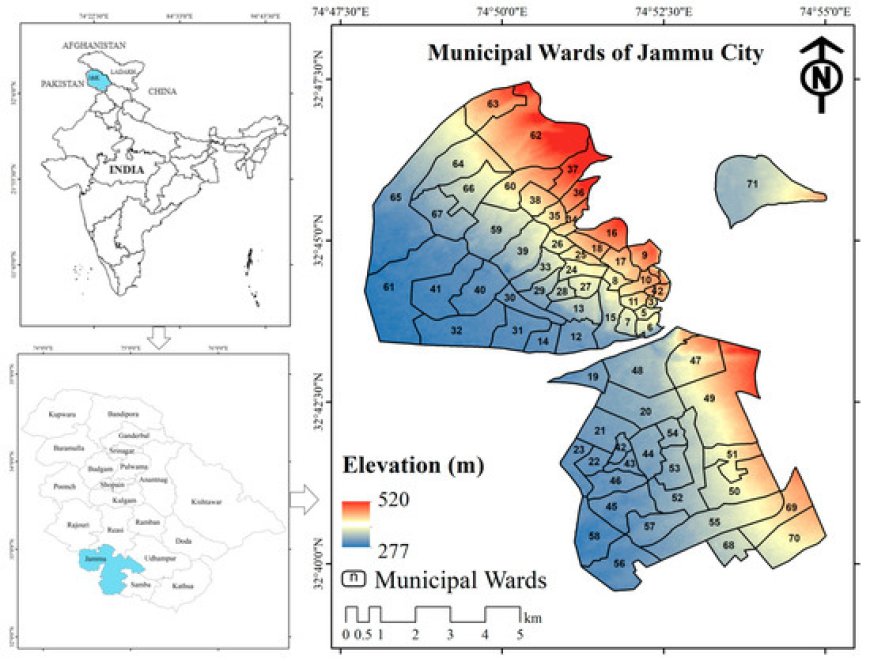
Evaluating inherent vulnerability, an intrinsic characteristic becomes imperative for the formulation of adaptation strategies, particularly in highly complex and vulnerable regions of Himalayas. Jammu City, situated in the north-western Himalayas within a transitional zone between the Himalayan range and the plains, is not only susceptible to intense seismic activities but also faces multiple hazards, including floods, earthquakes, avalanches, and landslides. In recent years, the region has experienced growth in population with rapid progress in infrastructure development, encompassing the construction of highways, dams, and tunnels as integral components of urban development initiatives. Therefore, this study has been conducted to assess the inherent vulnerability index (VI) in Jammu City at ward level as a function of sensitivity, adaptive capacity, and exposure, using ecological and social indicators in GIS environment. The primary objective was to identify the most vulnerable area and ascertain the corresponding municipal ward, aiming to formulate a comprehensive ranking. The 22 indicators analysed were from four major components, namely social, infrastructure, technological, and ecological. The ecological indicators like Land Surface Temperature (LST), Normalized Difference Vegetation Index (NDVI), and Land use/Land cover were derived from Landsat 8 OLI satellite data. The results show that the majority of the area of the city falls into the moderate (20%), high (25.49%), and very high (25.17%) vulnerability categories, respectively, clustered in north-western and south-western transects with densely populated residential areas. The results can assist policymakers in identification of components of inherent vulnerability for focused resource management and formulating adaptation strategies to address the current stressors in the region.
Climate, Vol. 12, Pages 12: Development of Inherent Vulnerability Index within Jammu Municipal Limits, India
Climate doi: 10.3390/cli12010012
Authors: Simran Bharti Adyan Ul Haq L. T. Sasang Guite Shruti Kanga Fayma Mushtaq Majid Farooq Suraj Kumar Singh Pankaj Kumar Gowhar Meraj
Evaluating inherent vulnerability, an intrinsic characteristic becomes imperative for the formulation of adaptation strategies, particularly in highly complex and vulnerable regions of Himalayas. Jammu City, situated in the north-western Himalayas within a transitional zone between the Himalayan range and the plains, is not only susceptible to intense seismic activities but also faces multiple hazards, including floods, earthquakes, avalanches, and landslides. In recent years, the region has experienced growth in population with rapid progress in infrastructure development, encompassing the construction of highways, dams, and tunnels as integral components of urban development initiatives. Therefore, this study has been conducted to assess the inherent vulnerability index (VI) in Jammu City at ward level as a function of sensitivity, adaptive capacity, and exposure, using ecological and social indicators in GIS environment. The primary objective was to identify the most vulnerable area and ascertain the corresponding municipal ward, aiming to formulate a comprehensive ranking. The 22 indicators analysed were from four major components, namely social, infrastructure, technological, and ecological. The ecological indicators like Land Surface Temperature (LST), Normalized Difference Vegetation Index (NDVI), and Land use/Land cover were derived from Landsat 8 OLI satellite data. The results show that the majority of the area of the city falls into the moderate (20%), high (25.49%), and very high (25.17%) vulnerability categories, respectively, clustered in north-western and south-western transects with densely populated residential areas. The results can assist policymakers in identification of components of inherent vulnerability for focused resource management and formulating adaptation strategies to address the current stressors in the region.
What's Your Reaction?