Environments, Vol. 11, Pages 71: Flexible Green Ammonia Production Plants: Small-Scale Simulations Based on Energy Aspects
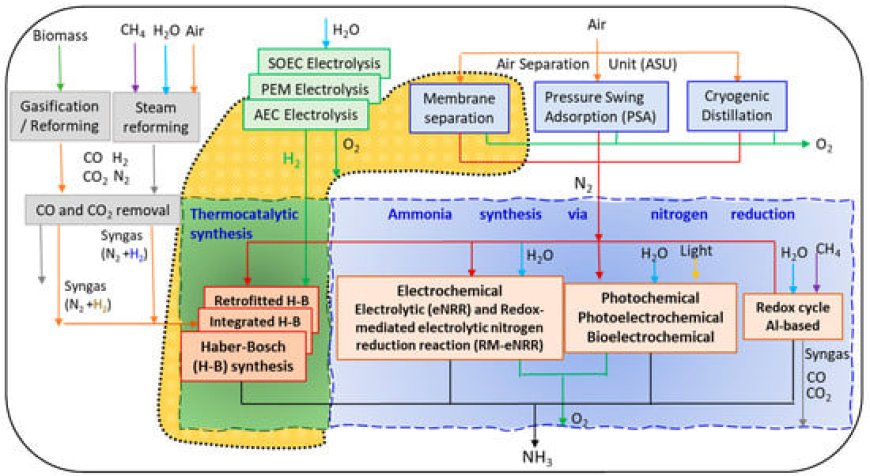
The conventional Haber–Bosch process (HBP) for NH3 production results in CO2 emissions of almost 400 Mt/y and is responsible for 1–2% of global energy consumption; furthermore, HBP requires large-scale industrial equipment. Green or e-ammonia produced with hydrogen from alkaline water electrolysis using renewable energy and nitrogen from the air is considered an alternative to fossil-fuel-based ammonia production. Small-scale plants with the distributed on-site production of e-ammonia will begin to supplant centralized manufacturing in a carbon-neutral framework due to its flexibility and agility. In this study, a flexible small-scale NH3 plant is analyzed with respect to three steps—H2 generation, air separation, and NH3 synthesis—to understand if milder operating conditions can benefit the process. This study investigates the aspects of flexible small-scale NH3 plants powered by alkaline electrolyzer units with three specific capacities: 1 MW, 5 MW, and 10 MW. The analysis is carried out through Aspen Plus V14 simulations, and the primary criteria for selecting the pressure, temperature, and number of reactors are based on the maximum ammonia conversion and minimum energy consumption. The results show that: (i) the plant can be operated across a wide range of process variables while maintaining low energy consumption and (ii) alkaline electrolysis is responsible for the majority of energy consumption, followed by the ammonia synthesis loop and the obtention of N2, which is negligible.
Environments, Vol. 11, Pages 71: Flexible Green Ammonia Production Plants: Small-Scale Simulations Based on Energy Aspects
Environments doi: 10.3390/environments11040071
Authors: Guillermo de la Hera Gema Ruiz-Gutiérrez Javier R. Viguri Berta Galán
The conventional Haber–Bosch process (HBP) for NH3 production results in CO2 emissions of almost 400 Mt/y and is responsible for 1–2% of global energy consumption; furthermore, HBP requires large-scale industrial equipment. Green or e-ammonia produced with hydrogen from alkaline water electrolysis using renewable energy and nitrogen from the air is considered an alternative to fossil-fuel-based ammonia production. Small-scale plants with the distributed on-site production of e-ammonia will begin to supplant centralized manufacturing in a carbon-neutral framework due to its flexibility and agility. In this study, a flexible small-scale NH3 plant is analyzed with respect to three steps—H2 generation, air separation, and NH3 synthesis—to understand if milder operating conditions can benefit the process. This study investigates the aspects of flexible small-scale NH3 plants powered by alkaline electrolyzer units with three specific capacities: 1 MW, 5 MW, and 10 MW. The analysis is carried out through Aspen Plus V14 simulations, and the primary criteria for selecting the pressure, temperature, and number of reactors are based on the maximum ammonia conversion and minimum energy consumption. The results show that: (i) the plant can be operated across a wide range of process variables while maintaining low energy consumption and (ii) alkaline electrolysis is responsible for the majority of energy consumption, followed by the ammonia synthesis loop and the obtention of N2, which is negligible.
What's Your Reaction?