Environments, Vol. 11, Pages 70: Dryland Soil Carbon and Nitrogen Stocks in Response to Cropping Systems and Nitrogen Fertilization
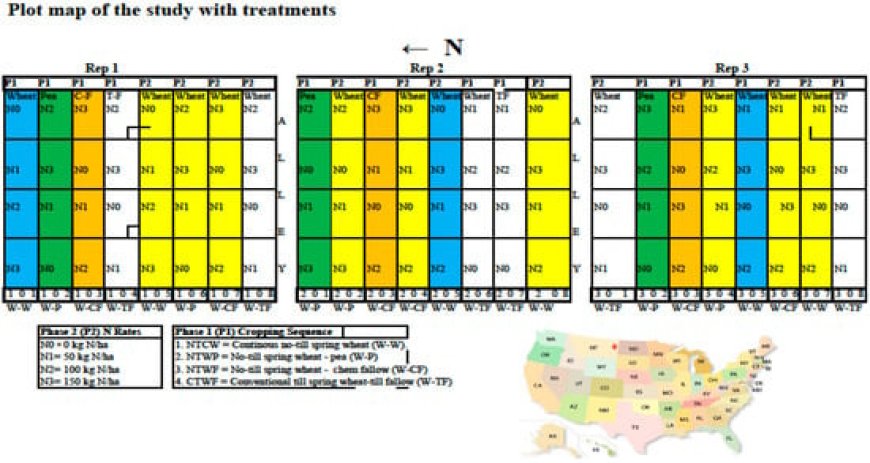
Innovative management practices are needed to mitigate greenhouse gas (GHG) emissions from the agricultural sector by enhancing soil carbon (C) and nitrogen (N) stocks, which serve as major reservoirs of C and N in the terrestrial ecosystem. The effect of cropping systems and N fertilization rates were examined on soil organic C (SOC) and soil total N (STN) stocks at the 0–120 cm depth from 2011 to 2018 in a dryland farm in the US northern Great Plains. Cropping systems were no-till continuous spring wheat (Triticum aestivum L.) (NTCW), no-till spring wheat–pea (Pisum sativum L.) (NTWP), no-till spring wheat–fallow (NTWF), and conventional till spring wheat–fallow (CTWF) and N fertilization rates were 0, 50, 100, and 150 kg N ha−1 applied to spring wheat. The SOC and STN were greater for NTWP than other cropping systems at most N fertilization rates and depth layers. Increasing N fertilization rate increased SOC at 0–30 cm for NTWP and NTCW, but had a variable effect on STN for various cropping systems and soil depths. The NTWP with 50–100 kg N ha−1 can enhance SOC and STN at 0–30 cm compared to other cropping systems and N fertilization rates in the US northern Great Plains.
Environments, Vol. 11, Pages 70: Dryland Soil Carbon and Nitrogen Stocks in Response to Cropping Systems and Nitrogen Fertilization
Environments doi: 10.3390/environments11040070
Authors: Upendra M. Sainju
Innovative management practices are needed to mitigate greenhouse gas (GHG) emissions from the agricultural sector by enhancing soil carbon (C) and nitrogen (N) stocks, which serve as major reservoirs of C and N in the terrestrial ecosystem. The effect of cropping systems and N fertilization rates were examined on soil organic C (SOC) and soil total N (STN) stocks at the 0–120 cm depth from 2011 to 2018 in a dryland farm in the US northern Great Plains. Cropping systems were no-till continuous spring wheat (Triticum aestivum L.) (NTCW), no-till spring wheat–pea (Pisum sativum L.) (NTWP), no-till spring wheat–fallow (NTWF), and conventional till spring wheat–fallow (CTWF) and N fertilization rates were 0, 50, 100, and 150 kg N ha−1 applied to spring wheat. The SOC and STN were greater for NTWP than other cropping systems at most N fertilization rates and depth layers. Increasing N fertilization rate increased SOC at 0–30 cm for NTWP and NTCW, but had a variable effect on STN for various cropping systems and soil depths. The NTWP with 50–100 kg N ha−1 can enhance SOC and STN at 0–30 cm compared to other cropping systems and N fertilization rates in the US northern Great Plains.
What's Your Reaction?