Water, Vol. 16, Pages 1170: An Investigation of Contaminant Transport and Retention from Storage Zone in Meandering Channels
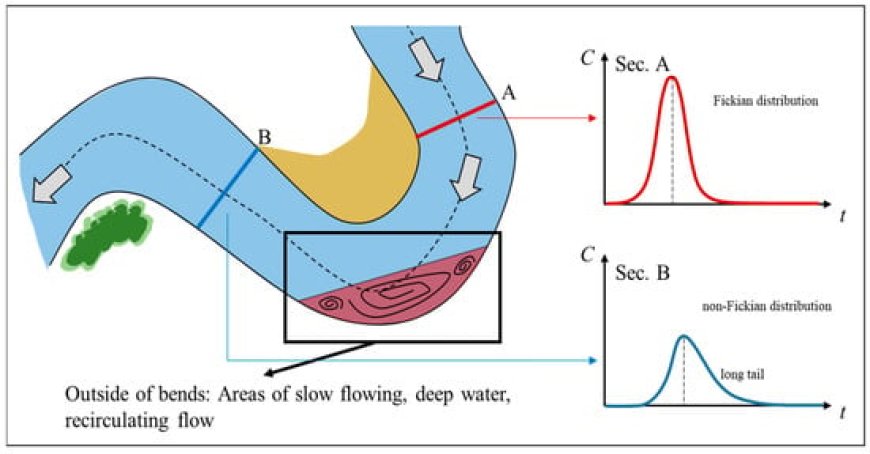
Contaminant trapping by recirculation zones occurring at the apex of natural meandering channels induces a long tail in the contaminant cloud, thereby complicating the prediction of mixing behaviors. Thus, the understanding of the interaction between solute trapping and recirculating flow is important for responding to and mitigating water pollution accidents. In this research, the EFDC model was employed to reproduce three-dimensional flow structures of recirculating flow at the channel apex and investigate the influence on contaminant mixing. To investigate the contaminant transport characteristics from the storage zone in meandering channels, simulations were conducted using various discharge values to assess the impact of storage zone development on the concentration–time curves. The analysis of the relationship between the storage zone size and mixing behaviors indicates that an increase in discharge could result in a shorter tail and larger longitudinal dispersion even with the larger storage zone size. On the other hand, the enlarged recirculation zone size contributes to reducing transverse dispersion, evidenced by flatter dosage curves under lower flow rate conditions. These findings suggest that the increase in longitudinal dispersion with a larger flow rate is primarily caused by the reduction in transverse dispersion resulting from the formation of the recirculation zone.
Water, Vol. 16, Pages 1170: An Investigation of Contaminant Transport and Retention from Storage Zone in Meandering Channels
Water doi: 10.3390/w16081170
Authors: Sung Hyun Jung Inhwan Park Jaehyun Shin
Contaminant trapping by recirculation zones occurring at the apex of natural meandering channels induces a long tail in the contaminant cloud, thereby complicating the prediction of mixing behaviors. Thus, the understanding of the interaction between solute trapping and recirculating flow is important for responding to and mitigating water pollution accidents. In this research, the EFDC model was employed to reproduce three-dimensional flow structures of recirculating flow at the channel apex and investigate the influence on contaminant mixing. To investigate the contaminant transport characteristics from the storage zone in meandering channels, simulations were conducted using various discharge values to assess the impact of storage zone development on the concentration–time curves. The analysis of the relationship between the storage zone size and mixing behaviors indicates that an increase in discharge could result in a shorter tail and larger longitudinal dispersion even with the larger storage zone size. On the other hand, the enlarged recirculation zone size contributes to reducing transverse dispersion, evidenced by flatter dosage curves under lower flow rate conditions. These findings suggest that the increase in longitudinal dispersion with a larger flow rate is primarily caused by the reduction in transverse dispersion resulting from the formation of the recirculation zone.
What's Your Reaction?