Climate, Vol. 12, Pages 77: Precipitation Extremes and Trends over the Uruguay River Basin in Southern South America
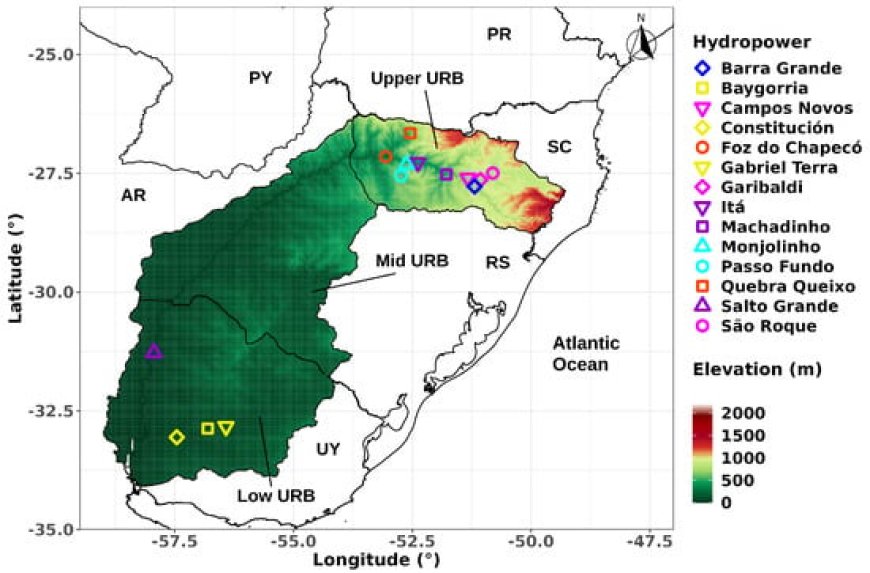
This study analyzes the spatial distribution and trends in five extreme daily rainfall indices in the Uruguay River Basin (URB) from 1993 to 2022 using the Climate Hazards Group Infrared Precipitation with Stations (CHIRPS) dataset. The main findings reveal a predominantly positive trend in heavy precipitation (R95p) and extreme precipitation (R99p) events over the mid URB, while a negative trend is observed in the upper and low URB. Significant trends in the frequency of heavy and extreme rainfall were observed during autumn (MAM), with positive trends across most of the mid and upper URB and negative trends in the low URB. In the upper URB, negative trends in the frequency of extremes were also found during spring (SON) and summer (DJF). Overall, there was a reduction in the number of consecutive wet days (CWD), particularly significant in the upper URB and the northern half of the mid URB. Additionally, the upper URB experienced an overall increase in the duration of consecutive dry days (CDD).
Climate, Vol. 12, Pages 77: Precipitation Extremes and Trends over the Uruguay River Basin in Southern South America
Climate doi: 10.3390/cli12060077
Authors: Vanessa Ferreira Osmar Toledo Bonfim Rafael Maroneze Luca Mortarini Roilan Hernandez Valdes Felipe Denardin Costa
This study analyzes the spatial distribution and trends in five extreme daily rainfall indices in the Uruguay River Basin (URB) from 1993 to 2022 using the Climate Hazards Group Infrared Precipitation with Stations (CHIRPS) dataset. The main findings reveal a predominantly positive trend in heavy precipitation (R95p) and extreme precipitation (R99p) events over the mid URB, while a negative trend is observed in the upper and low URB. Significant trends in the frequency of heavy and extreme rainfall were observed during autumn (MAM), with positive trends across most of the mid and upper URB and negative trends in the low URB. In the upper URB, negative trends in the frequency of extremes were also found during spring (SON) and summer (DJF). Overall, there was a reduction in the number of consecutive wet days (CWD), particularly significant in the upper URB and the northern half of the mid URB. Additionally, the upper URB experienced an overall increase in the duration of consecutive dry days (CDD).
What's Your Reaction?