Hydrology, Vol. 10, Pages 208: Assessment of Time Series Models for Mean Discharge Modeling and Forecasting in a Sub-Basin of the Paranaíba River, Brazil
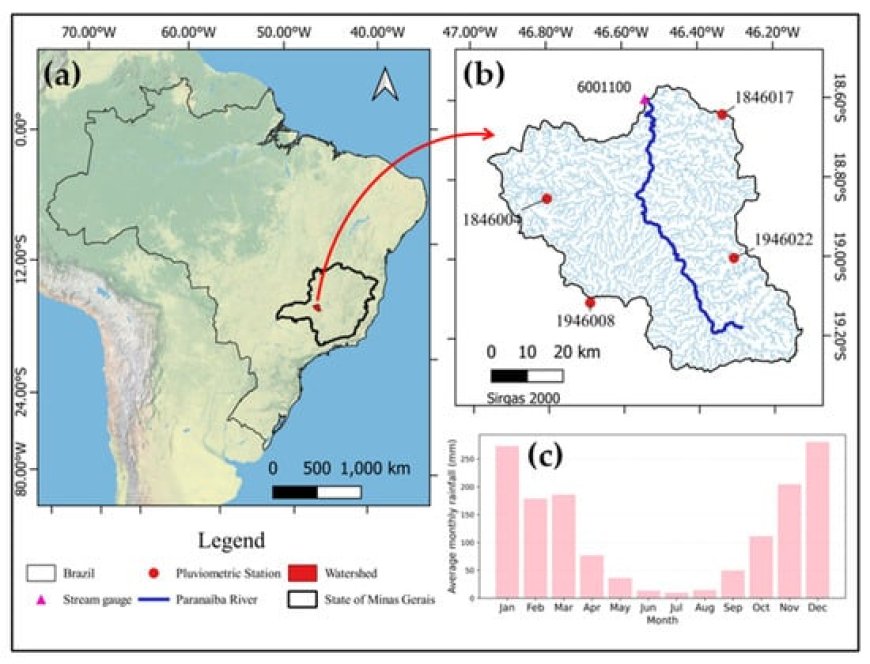
Stochastic modeling to forecast hydrological variables under changing climatic conditions is essential for water resource management and adaptation planning. This study explores the applicability of stochastic models, specifically SARIMA and SARIMAX, to forecast monthly average river discharge in a sub-basin of the Paranaíba River near Patos de Minas, MG, Brazil. The Paranaíba River is a vital water source for the Alto Paranaíba region, serving industrial supply, drinking water effluent dilution for urban communities, agriculture, fishing, and tourism. The study evaluates the performance of SARIMA and SARIMAX models in long-term discharge modeling and forecasting, demonstrating the SARIMAX model’s superior performance in various metrics, including the Nash–Sutcliffe coefficient (NSE), the root mean square error (RMSE), and the mean absolute percentage error (MAPE). The inclusion of precipitation as a regressor variable considerably improves the forecasting accuracy, and can be attributed to the multivariate structure of the SARIMAX model. While stochastic models like SARIMAX offer valuable decision-making tools for water resource management, the study underscores the significance of employing long-term time series encompassing flood and drought periods and including model uncertainty analysis to enhance the robustness of forecasts. In this study, the SARIMAX model provides a better fit for extreme values, overestimating peaks by around 11.6% and troughs by about 5.0%, compared with the SARIMA model, which tends to underestimate peaks by an average of 6.5% and overestimate troughs by approximately 76.0%. The findings contribute to the literature on water management strategies and mitigating risks associated with extreme hydrological events.
Hydrology, Vol. 10, Pages 208: Assessment of Time Series Models for Mean Discharge Modeling and Forecasting in a Sub-Basin of the Paranaíba River, Brazil
Hydrology doi: 10.3390/hydrology10110208
Authors: Gabriela Emiliana de Melo e Costa Frederico Carlos M. de Menezes Filho Fausto A. Canales Maria Clara Fava Abderraman R. Amorim Brandão Rafael Pedrollo de Paes
Stochastic modeling to forecast hydrological variables under changing climatic conditions is essential for water resource management and adaptation planning. This study explores the applicability of stochastic models, specifically SARIMA and SARIMAX, to forecast monthly average river discharge in a sub-basin of the Paranaíba River near Patos de Minas, MG, Brazil. The Paranaíba River is a vital water source for the Alto Paranaíba region, serving industrial supply, drinking water effluent dilution for urban communities, agriculture, fishing, and tourism. The study evaluates the performance of SARIMA and SARIMAX models in long-term discharge modeling and forecasting, demonstrating the SARIMAX model’s superior performance in various metrics, including the Nash–Sutcliffe coefficient (NSE), the root mean square error (RMSE), and the mean absolute percentage error (MAPE). The inclusion of precipitation as a regressor variable considerably improves the forecasting accuracy, and can be attributed to the multivariate structure of the SARIMAX model. While stochastic models like SARIMAX offer valuable decision-making tools for water resource management, the study underscores the significance of employing long-term time series encompassing flood and drought periods and including model uncertainty analysis to enhance the robustness of forecasts. In this study, the SARIMAX model provides a better fit for extreme values, overestimating peaks by around 11.6% and troughs by about 5.0%, compared with the SARIMA model, which tends to underestimate peaks by an average of 6.5% and overestimate troughs by approximately 76.0%. The findings contribute to the literature on water management strategies and mitigating risks associated with extreme hydrological events.
What's Your Reaction?