Climate, Vol. 12, Pages 28: Atmospheric Patterns in Porto Velho, Rondônia, Southwestern Amazon, in a Rhythmic Context between 2017 and 2018
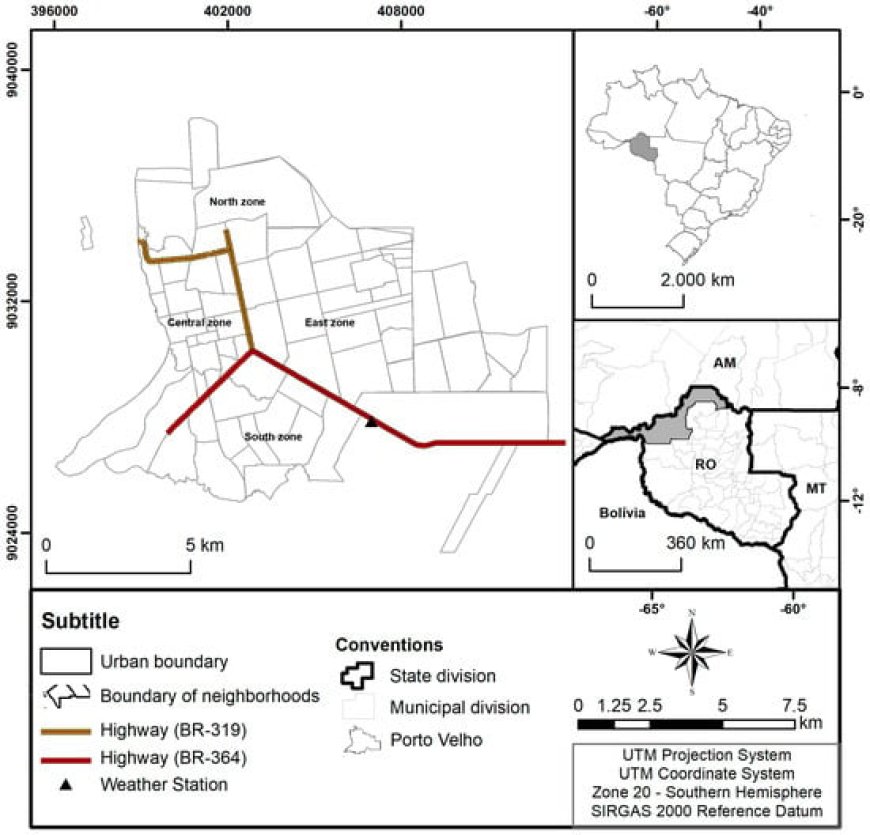
This paper aims to analyze the weather conditions in Porto Velho (Rondonia, Brazil, Western Amazon) and the influence of air masses on the climatic elements between 2017 and 2018, using rhythmic analysis. Climatic data were obtained through the official weather station, tabulated and statistically organized, and processed in R Studio programming language. The monitoring of air masses occurred through the synoptic charts of the Navy Hydrography Center. The results were analyzed by dry–rainy transition season, rainy season, wet–dry transition season, and dry season. Thus, the results point out that the Tropical Continental mass (mTc) acted up to 62.9%, responsible for the low precipitation index in October 2017. Although the mass has characteristics of warm and unstable weather, it is even lower than the action of the mEc. In January 2018, there was an 85.5% prevalence of the Continental Equatorial Mass (mEc), added to the action of the South Atlantic Convergence Zone (ZCAS), which contributed to an accumulated rainfall of 443 mm/month. In April 2018, the mEC acted with 56.7%, reaching 35.5% in August. Another highlight was the performance of the Tropical Atlantic mass (mTa) (27.4%) and mTc (19.4%), both of which had a crucial role in the dry season, followed by the Polar Atlantic mass (mPa) (17.7%), that contributed to the phenomenon of “coldness” in the region. Therefore, the mEc is extremely important in the control of the relative humidity of the air and the precipitations, while the mTc is a dissipator of winds that, at times, inhibits the performance of the mEc.
Climate, Vol. 12, Pages 28: Atmospheric Patterns in Porto Velho, Rondônia, Southwestern Amazon, in a Rhythmic Context between 2017 and 2018
Climate doi: 10.3390/cli12030028
Authors: Graziela T. Tejas Dorisvalder D. Nunes Reginaldo M. S. Souza Carlos A. S. Querino Marlon R. Faria Daiana C. B. Floresta Emerson Galvani Michel Watanabe João P. A. Gobo
This paper aims to analyze the weather conditions in Porto Velho (Rondonia, Brazil, Western Amazon) and the influence of air masses on the climatic elements between 2017 and 2018, using rhythmic analysis. Climatic data were obtained through the official weather station, tabulated and statistically organized, and processed in R Studio programming language. The monitoring of air masses occurred through the synoptic charts of the Navy Hydrography Center. The results were analyzed by dry–rainy transition season, rainy season, wet–dry transition season, and dry season. Thus, the results point out that the Tropical Continental mass (mTc) acted up to 62.9%, responsible for the low precipitation index in October 2017. Although the mass has characteristics of warm and unstable weather, it is even lower than the action of the mEc. In January 2018, there was an 85.5% prevalence of the Continental Equatorial Mass (mEc), added to the action of the South Atlantic Convergence Zone (ZCAS), which contributed to an accumulated rainfall of 443 mm/month. In April 2018, the mEC acted with 56.7%, reaching 35.5% in August. Another highlight was the performance of the Tropical Atlantic mass (mTa) (27.4%) and mTc (19.4%), both of which had a crucial role in the dry season, followed by the Polar Atlantic mass (mPa) (17.7%), that contributed to the phenomenon of “coldness” in the region. Therefore, the mEc is extremely important in the control of the relative humidity of the air and the precipitations, while the mTc is a dissipator of winds that, at times, inhibits the performance of the mEc.
What's Your Reaction?