Environments, Vol. 10, Pages 215: Coupled Photocatalysis and Microalgal–Bacterial Synergy System for Continuously Treating Aquaculture Wastewater Containing Real Phthalate Esters
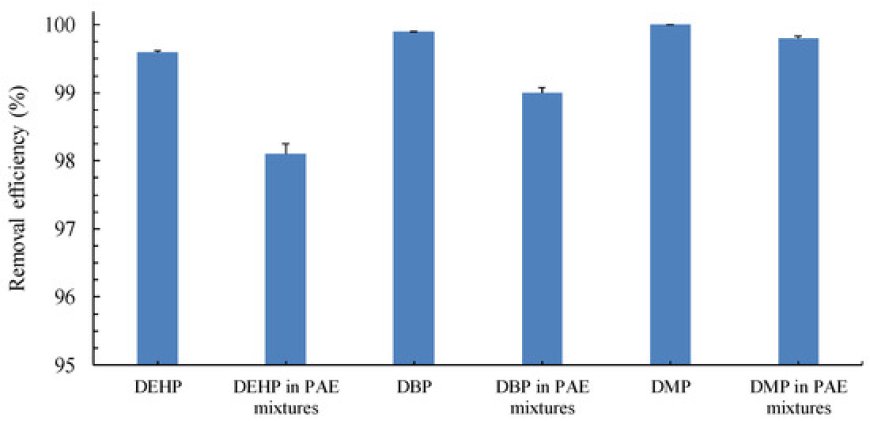
We developed a system combining visible-light photocatalysis with biological treatment for the continuous removal of phthalate esters (PAEs) from both synthetic and real aquaculture wastewater. We investigated the effects of different operating factors, including the coexistence of glucose or PAEs, on individual PAE removal by using a photobiological system (PBS). In wastewater containing a mixture of PAEs, that is, containing di-(2-ethylhexyl)phthalate (DEHP), dibutyl phthalate (DBP), and dimethyl phthalate (DMP), a coimmobilized bioreactor system comprising the bacterium Pseudomonas putida and the microalga Chlorella vulgaris demonstrated a higher removal efficiency than immobilized P. putida alone or a coculture of immobilized P. putida and suspended C. vulgaris did. The PBS employed for the continuous treatment of real aquaculture wastewater containing DEHP (0.62 ± 0.05 mg/L), DBP (8.7 ± 0.9 mg/L), and DMP (17.4 ± 1.5 mg/L) achieved at least 99.5% PAE removal and 99.2% mineralization efficiency under optimal operating conditions. After 42 days of treatment, inoculated Pseudomonas (98.12%) remained the predominant genus in the bioreactor. The results reveal that the symbiotic microalgal–bacterial system is a feasible alternative to a pure P. putida immobilized bioreactor for reducing CO2 emissions from mineralized PAEs through microalgal activity.
Environments, Vol. 10, Pages 215: Coupled Photocatalysis and Microalgal–Bacterial Synergy System for Continuously Treating Aquaculture Wastewater Containing Real Phthalate Esters
Environments doi: 10.3390/environments10120215
Authors: Ying-Chien Chung Chih-Yu Chen
We developed a system combining visible-light photocatalysis with biological treatment for the continuous removal of phthalate esters (PAEs) from both synthetic and real aquaculture wastewater. We investigated the effects of different operating factors, including the coexistence of glucose or PAEs, on individual PAE removal by using a photobiological system (PBS). In wastewater containing a mixture of PAEs, that is, containing di-(2-ethylhexyl)phthalate (DEHP), dibutyl phthalate (DBP), and dimethyl phthalate (DMP), a coimmobilized bioreactor system comprising the bacterium Pseudomonas putida and the microalga Chlorella vulgaris demonstrated a higher removal efficiency than immobilized P. putida alone or a coculture of immobilized P. putida and suspended C. vulgaris did. The PBS employed for the continuous treatment of real aquaculture wastewater containing DEHP (0.62 ± 0.05 mg/L), DBP (8.7 ± 0.9 mg/L), and DMP (17.4 ± 1.5 mg/L) achieved at least 99.5% PAE removal and 99.2% mineralization efficiency under optimal operating conditions. After 42 days of treatment, inoculated Pseudomonas (98.12%) remained the predominant genus in the bioreactor. The results reveal that the symbiotic microalgal–bacterial system is a feasible alternative to a pure P. putida immobilized bioreactor for reducing CO2 emissions from mineralized PAEs through microalgal activity.
What's Your Reaction?