Climate, Vol. 12, Pages 109: Emergence of Arctic Extremes
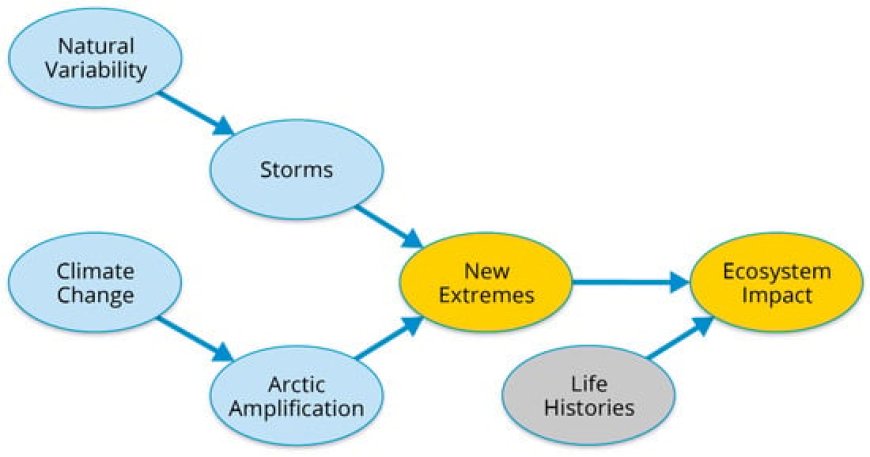
Recent increases in extreme events, especially those near and beyond previous records, are a new index for Arctic and global climate change. They vary by type, location, and season. These record-shattering events often have no known historical analogues and suggest that other climate surprises are in store. Twenty-six unprecedented events from 2022, 2023, and early 2024 include record summer temperatures/heatwaves, storms, major Canadian wildfires, early continental snow melt, Greenland melt, sea temperatures of 5–7 °C above normal, drought in Iceland, and low northern Alaskan salmon runs. Collectively, such diverse extremes form a consilience, the principle that evidence from independent, unrelated sources converge as a strong indicator of ongoing Arctic change. These new behaviors represent emergent phenomenon. Emergence occurs when multiple processes interact to produce new properties, such as the interaction of Arctic amplification with the normal range of major weather events. Examples are typhon Merbok that resulted in extensive coastal erosion in the Bering Sea, Greenland melt, and record temperatures and melt in Svalbard. The Arctic can now be considered to be in a different state to before fifteen years ago. Communities must adapt for such intermittent events to avoid worst-case scenarios.
Climate, Vol. 12, Pages 109: Emergence of Arctic Extremes
Climate doi: 10.3390/cli12080109
Authors: James E. Overland
Recent increases in extreme events, especially those near and beyond previous records, are a new index for Arctic and global climate change. They vary by type, location, and season. These record-shattering events often have no known historical analogues and suggest that other climate surprises are in store. Twenty-six unprecedented events from 2022, 2023, and early 2024 include record summer temperatures/heatwaves, storms, major Canadian wildfires, early continental snow melt, Greenland melt, sea temperatures of 5–7 °C above normal, drought in Iceland, and low northern Alaskan salmon runs. Collectively, such diverse extremes form a consilience, the principle that evidence from independent, unrelated sources converge as a strong indicator of ongoing Arctic change. These new behaviors represent emergent phenomenon. Emergence occurs when multiple processes interact to produce new properties, such as the interaction of Arctic amplification with the normal range of major weather events. Examples are typhon Merbok that resulted in extensive coastal erosion in the Bering Sea, Greenland melt, and record temperatures and melt in Svalbard. The Arctic can now be considered to be in a different state to before fifteen years ago. Communities must adapt for such intermittent events to avoid worst-case scenarios.
What's Your Reaction?