Climate, Vol. 11, Pages 223: Regional to Mesoscale Influences of Climate Indices on Tornado Variability
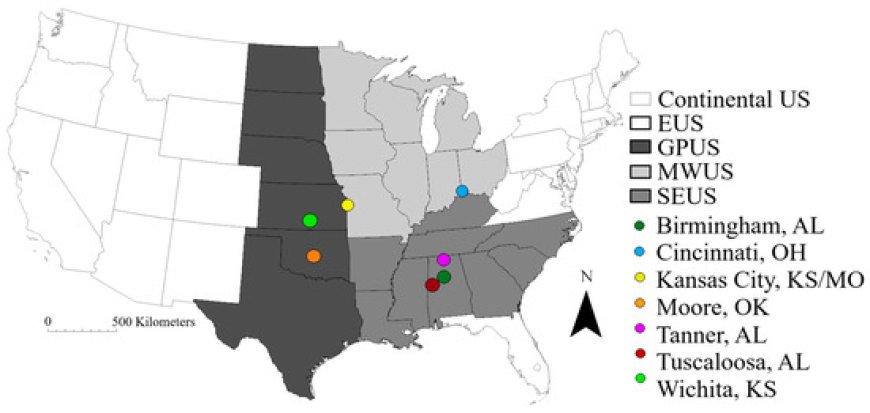
Tornadoes present an undisputable danger to communities throughout the United States. Despite this known risk, there is a limited understanding of how tornado frequency varies spatially at the mesoscale across county or city area domains. Furthermore, while previous studies have examined the relationships between various climate indices and continental or regional tornado frequency, little research has examined their influence at a smaller scale. This study examines the relationships between various climate indices and regional tornado frequency alongside the same relationships at the mesoscale in seven cities with anomalous tornado patterns. The results of a correlation analysis and generalized linear modeling show common trends between the regions and cities. The strength of the relationships varied by region, but, overall, the ENSO had the greatest influence on tornado frequency, followed in order by the PNA, AO, NAO, MJO, and PDO. However, future research is critical for understanding how the effects of climate indices on tornado frequency vary at different spatial scales, or whether other factors are responsible for the atypical tornado rates in certain cities.
Climate, Vol. 11, Pages 223: Regional to Mesoscale Influences of Climate Indices on Tornado Variability
Climate doi: 10.3390/cli11110223
Authors: Cooper P. Corey Jason C. Senkbeil
Tornadoes present an undisputable danger to communities throughout the United States. Despite this known risk, there is a limited understanding of how tornado frequency varies spatially at the mesoscale across county or city area domains. Furthermore, while previous studies have examined the relationships between various climate indices and continental or regional tornado frequency, little research has examined their influence at a smaller scale. This study examines the relationships between various climate indices and regional tornado frequency alongside the same relationships at the mesoscale in seven cities with anomalous tornado patterns. The results of a correlation analysis and generalized linear modeling show common trends between the regions and cities. The strength of the relationships varied by region, but, overall, the ENSO had the greatest influence on tornado frequency, followed in order by the PNA, AO, NAO, MJO, and PDO. However, future research is critical for understanding how the effects of climate indices on tornado frequency vary at different spatial scales, or whether other factors are responsible for the atypical tornado rates in certain cities.
What's Your Reaction?