Water, Vol. 16, Pages 1226: An Assessment of the Suitability of Contrasting Biosolids for Raising Indigenous Plants in Nurseries
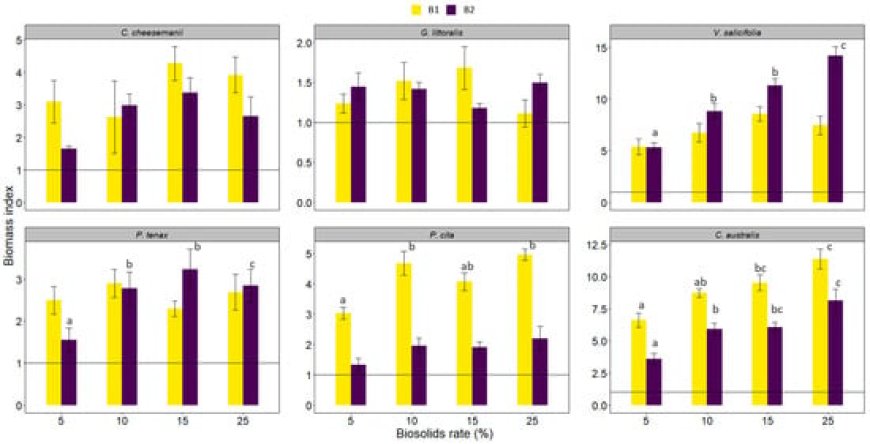
Disposal of biosolids, the solid fraction of sewage treatment, is a global environmental issue. Biosolids contain valuable organic matter and plant nutrients; however, they also contain contaminants including trace elements, xenobiotics, and pathogens. The quality of the biosolids greatly depends on the source of wastewater (i.e., industrial vs. domestic) and the treatment processes. We aimed to determine the potential of three distinct biosolids and one pond sludge to grow indigenous plants for ecosystem restoration. For each amendment, we tested six indigenous species, Veronica salicifolia, Corokia cheesemanii, Griselinia littoralis, Phormium tenax, Poa cita, and Cordyline australis in bark mixed with biosolids and/or pond sludge at rates of 0–50%. There was a significant positive correlation between plant growth and biosolid addition up to a species-dependent plateau. Growth decreased at the highest rates. At a rate of 10% for fresh biosolids and 30% for aged biosolids provided consistent optimal growth across all species. The pond sludge was unsuitable for the establishment of indigenous seedlings. At the optimal rates, there were significant increases in foliar N, P, K, S, and Zn. None of the trace elements accumulated in the plants at phytotoxic concentrations or levels that presented a risk to ecosystems. Future work should determine how plants raised with biosolids perform once planted out in the field.
Water, Vol. 16, Pages 1226: An Assessment of the Suitability of Contrasting Biosolids for Raising Indigenous Plants in Nurseries
Water doi: 10.3390/w16091226
Authors: Claudia Garcés-Hernández Brett Robinson Claudio Bravo-Linares Hamish Lowe Seinalyn Villanueva Jennifer Prosser María-Jesús Gutiérrez-Ginés
Disposal of biosolids, the solid fraction of sewage treatment, is a global environmental issue. Biosolids contain valuable organic matter and plant nutrients; however, they also contain contaminants including trace elements, xenobiotics, and pathogens. The quality of the biosolids greatly depends on the source of wastewater (i.e., industrial vs. domestic) and the treatment processes. We aimed to determine the potential of three distinct biosolids and one pond sludge to grow indigenous plants for ecosystem restoration. For each amendment, we tested six indigenous species, Veronica salicifolia, Corokia cheesemanii, Griselinia littoralis, Phormium tenax, Poa cita, and Cordyline australis in bark mixed with biosolids and/or pond sludge at rates of 0–50%. There was a significant positive correlation between plant growth and biosolid addition up to a species-dependent plateau. Growth decreased at the highest rates. At a rate of 10% for fresh biosolids and 30% for aged biosolids provided consistent optimal growth across all species. The pond sludge was unsuitable for the establishment of indigenous seedlings. At the optimal rates, there were significant increases in foliar N, P, K, S, and Zn. None of the trace elements accumulated in the plants at phytotoxic concentrations or levels that presented a risk to ecosystems. Future work should determine how plants raised with biosolids perform once planted out in the field.
What's Your Reaction?