Water, Vol. 16, Pages 1129: Decoupling Agricultural Grey Water Footprint from Economic Growth in the Yellow River Basin
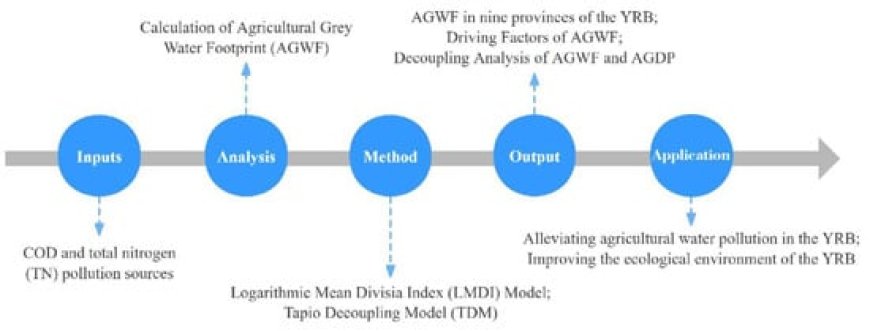
Decoupling agricultural economic growth from agricultural water pollution is of great importance to regional sustainable development. It is necessary to further explore the decoupling state and key driving factors connecting agricultural water pollution and agricultural economic growth on the basis of accurate measurement of agricultural water pollution. Accordingly, taking the Yellow River Basin (YRB) as the research object, this study combined the water footprint theory, the Logarithmic Mean Divisia Index (LMDI) model and the Tapio decoupling model (TDM) to conduct an in-depth decoupling analysis of the connection between the agricultural grey water footprint (AGWF) and agricultural economic growth in the YRB. Specifically, this study first calculated the AGWF of the YRB during 2016–2021 and objectively evaluated the water resource utilization in this region based on the AGWF. Then, the LMDI model was used to explore the driving factors of the AGWF in the YRB. Finally, the decoupling states between the AGWF and its driving factors with agricultural GDP (AGDP) were studied using the TDM. The main results are as follows: (1) The overall AGWF in the YRB showed a decreasing trend and a slow increase, decreasing by 5.39% in 2021 compared to 2016. (2) The primary promoting factor and inhibiting factor of AGWF reduction are the efficiency effect and agricultural economic effect, respectively. (3) The decoupling states of the AGWF and AGDP presented strong decoupling (SD) and then weak decoupling (WD) in the YRB during the research period. The decoupling states between the agricultural grey water footprint intensity (AGWFI) and AGDP changed from expansive negative decoupling (END) to SD. The decoupling state of population and AGDP remained SD. This study will contribute to alleviating agricultural water pollution in the YRB and help policymakers in water-stressed countries to formulate agricultural water management policies.
Water, Vol. 16, Pages 1129: Decoupling Agricultural Grey Water Footprint from Economic Growth in the Yellow River Basin
Water doi: 10.3390/w16081129
Authors: Xiaoyan Zhang Yunan Xiao Thomas Stephen Ramsey Songpu Li Qingling Peng
Decoupling agricultural economic growth from agricultural water pollution is of great importance to regional sustainable development. It is necessary to further explore the decoupling state and key driving factors connecting agricultural water pollution and agricultural economic growth on the basis of accurate measurement of agricultural water pollution. Accordingly, taking the Yellow River Basin (YRB) as the research object, this study combined the water footprint theory, the Logarithmic Mean Divisia Index (LMDI) model and the Tapio decoupling model (TDM) to conduct an in-depth decoupling analysis of the connection between the agricultural grey water footprint (AGWF) and agricultural economic growth in the YRB. Specifically, this study first calculated the AGWF of the YRB during 2016–2021 and objectively evaluated the water resource utilization in this region based on the AGWF. Then, the LMDI model was used to explore the driving factors of the AGWF in the YRB. Finally, the decoupling states between the AGWF and its driving factors with agricultural GDP (AGDP) were studied using the TDM. The main results are as follows: (1) The overall AGWF in the YRB showed a decreasing trend and a slow increase, decreasing by 5.39% in 2021 compared to 2016. (2) The primary promoting factor and inhibiting factor of AGWF reduction are the efficiency effect and agricultural economic effect, respectively. (3) The decoupling states of the AGWF and AGDP presented strong decoupling (SD) and then weak decoupling (WD) in the YRB during the research period. The decoupling states between the agricultural grey water footprint intensity (AGWFI) and AGDP changed from expansive negative decoupling (END) to SD. The decoupling state of population and AGDP remained SD. This study will contribute to alleviating agricultural water pollution in the YRB and help policymakers in water-stressed countries to formulate agricultural water management policies.
What's Your Reaction?