Climate, Vol. 11, Pages 208: Modeling the Effects of Local Atmospheric Conditions on the Thermodynamics of Sobradinho Lake, Northeast Brazil
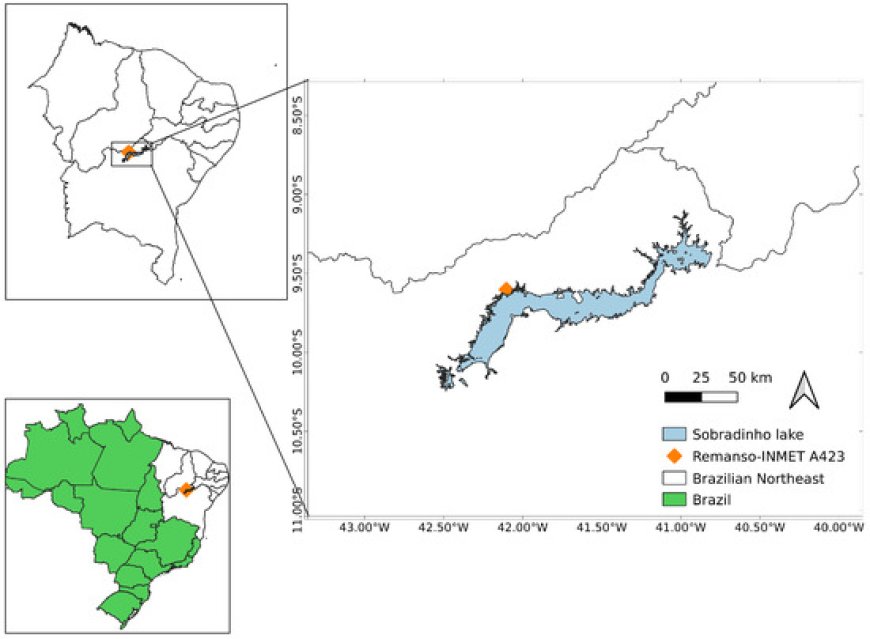
The objective of this work was to study climate variability and its impacts on the temperature of Sobradinho Lake in Northeast Brazil. Surface weather station data and lake measurements were used in this study. The model applied in this work is FLake, which is a one-dimensional model used to simulate the vertical temperature profile of freshwater lakes. First, the climate variability around Sobradinho Lake was analyzed. Observations showed a reduction in precipitation during 1991–2020 compared to 1981–2010. To study climate variability impacts on Sobradinho Lake, the years 2013, 2015, and 2020 were selected to characterize normal, dry, and rainy years, respectively. In addition, the months of January, April, July, and October were analyzed for rainy months, rainy–dry transitions, dry months, and dry–rainy transitions. Dry years showed higher incoming solar radiation at the surface and, consequently, higher 2 m air temperatures. A characteristic of the normal years was more intense surface winds. October presented the highest incoming solar radiation, the highest air temperature, and the most intense winds at the surface. The lowest incoming solar radiation at the surface was observed in January, and the lightest wind was observed in April. To assess the effects of these atmospheric conditions on the thermodynamics of Sobradinho Lake, the FLake model was forced using station observation data. The thermal amplitude of the lake surface temperature (LST) varied by less than 1 °C during the four months. This result was validated against surface lake observations. FLake was able to accurately reproduce the diurnal cycle variation in sensible heat fluxes (H), latent heat fluxes, and momentum fluxes. The sensible heat flux depends directly on the difference between the LST and the air temperature. During daytime, however, Flake simulated negative values of H, and during nighttime, positive values. The highest values of latent heat flux were simulated during the day, with the maximum value was simulated at 12:00 noon. The momentum flux simulated a similar pattern, with the maximum values simulated during the day and the minimum values during the night. The FLake model also simulated the deepest mixing layer in the months of July and October. However, our results have limitations due to the lack of observed data to validate the simulations.
Climate, Vol. 11, Pages 208: Modeling the Effects of Local Atmospheric Conditions on the Thermodynamics of Sobradinho Lake, Northeast Brazil
Climate doi: 10.3390/cli11100208
Authors: Eliseu Oliveira Afonso Sin Chan Chou
The objective of this work was to study climate variability and its impacts on the temperature of Sobradinho Lake in Northeast Brazil. Surface weather station data and lake measurements were used in this study. The model applied in this work is FLake, which is a one-dimensional model used to simulate the vertical temperature profile of freshwater lakes. First, the climate variability around Sobradinho Lake was analyzed. Observations showed a reduction in precipitation during 1991–2020 compared to 1981–2010. To study climate variability impacts on Sobradinho Lake, the years 2013, 2015, and 2020 were selected to characterize normal, dry, and rainy years, respectively. In addition, the months of January, April, July, and October were analyzed for rainy months, rainy–dry transitions, dry months, and dry–rainy transitions. Dry years showed higher incoming solar radiation at the surface and, consequently, higher 2 m air temperatures. A characteristic of the normal years was more intense surface winds. October presented the highest incoming solar radiation, the highest air temperature, and the most intense winds at the surface. The lowest incoming solar radiation at the surface was observed in January, and the lightest wind was observed in April. To assess the effects of these atmospheric conditions on the thermodynamics of Sobradinho Lake, the FLake model was forced using station observation data. The thermal amplitude of the lake surface temperature (LST) varied by less than 1 °C during the four months. This result was validated against surface lake observations. FLake was able to accurately reproduce the diurnal cycle variation in sensible heat fluxes (H), latent heat fluxes, and momentum fluxes. The sensible heat flux depends directly on the difference between the LST and the air temperature. During daytime, however, Flake simulated negative values of H, and during nighttime, positive values. The highest values of latent heat flux were simulated during the day, with the maximum value was simulated at 12:00 noon. The momentum flux simulated a similar pattern, with the maximum values simulated during the day and the minimum values during the night. The FLake model also simulated the deepest mixing layer in the months of July and October. However, our results have limitations due to the lack of observed data to validate the simulations.
What's Your Reaction?