CivilEng, Vol. 4, Pages 702-725: Soil–Structure Interaction Effects on Seismic Responses of a Conventional and Isolated Bridge Subjected to Moderate Near-Fault and Far-Field Records
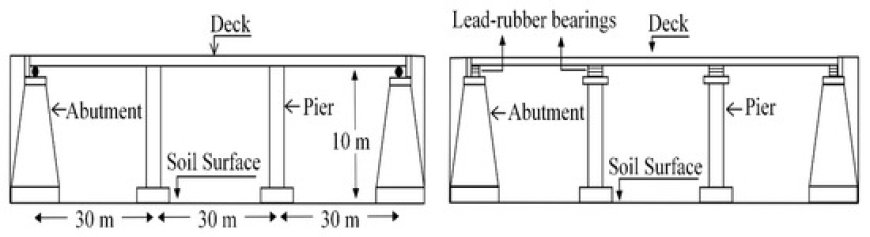
Seismic isolation is a powerful tool for mitigating seismic risk and improving structural performance. However, some parameters, such as earthquake inputs and soil characteristics, influence the technology’s performance. This research aims to investigate the effects of soil–structure interaction (SSI) with regard to different moderate earthquakes associated with different distances of the source to the site, frequency content, and different soil characteristics on the seismic response of the isolated bridges. Near-fault (NF) and far-field (FF) records are applied to the conventional and isolated bridge with and without considering the underlying soil. For this reason, using the direct and simplified methods, three soil properties representing rock, dense, and stiff soils are modeled in Abaqus software. Nonlinear time history analysis (NLTHA) is carried out, and structural responses of both approaches in terms of maximum deck acceleration, base shear, and displacement of the deck and the isolation system are studied. Results demonstrate that the difference between the two approaches is significant. Using the simplified method is a rather simple approach that roughly captures the important features of the record characteristics and SSI. Furthermore, careful attention should be paid to the base shear responses and the isolator displacement demands, as they are significantly amplified in softer soils. In addition, the peak ground acceleration to peak ground velocity ratio (PGA/PGV) plays a decisive role in all dynamic responses. Records with a lower PGA/PGV ratio cause higher dynamic responses in terms of displacement and acceleration/force, regardless of the distance of the ruptured fault, while NF records show higher dynamic responses compared to FF records.
CivilEng, Vol. 4, Pages 702-725: Soil–Structure Interaction Effects on Seismic Responses of a Conventional and Isolated Bridge Subjected to Moderate Near-Fault and Far-Field Records
CivilEng doi: 10.3390/civileng4030040
Authors: Nastaran Cheshmehkaboodi Lotfi Guizani Noureddine Ghlamallah
Seismic isolation is a powerful tool for mitigating seismic risk and improving structural performance. However, some parameters, such as earthquake inputs and soil characteristics, influence the technology’s performance. This research aims to investigate the effects of soil–structure interaction (SSI) with regard to different moderate earthquakes associated with different distances of the source to the site, frequency content, and different soil characteristics on the seismic response of the isolated bridges. Near-fault (NF) and far-field (FF) records are applied to the conventional and isolated bridge with and without considering the underlying soil. For this reason, using the direct and simplified methods, three soil properties representing rock, dense, and stiff soils are modeled in Abaqus software. Nonlinear time history analysis (NLTHA) is carried out, and structural responses of both approaches in terms of maximum deck acceleration, base shear, and displacement of the deck and the isolation system are studied. Results demonstrate that the difference between the two approaches is significant. Using the simplified method is a rather simple approach that roughly captures the important features of the record characteristics and SSI. Furthermore, careful attention should be paid to the base shear responses and the isolator displacement demands, as they are significantly amplified in softer soils. In addition, the peak ground acceleration to peak ground velocity ratio (PGA/PGV) plays a decisive role in all dynamic responses. Records with a lower PGA/PGV ratio cause higher dynamic responses in terms of displacement and acceleration/force, regardless of the distance of the ruptured fault, while NF records show higher dynamic responses compared to FF records.
What's Your Reaction?