CivilEng, Vol. 4, Pages 483-505: Numerical Modeling and Analysis of Strengthened Steel–Concrete Composite Beams in Sagging and Hogging Moment Regions
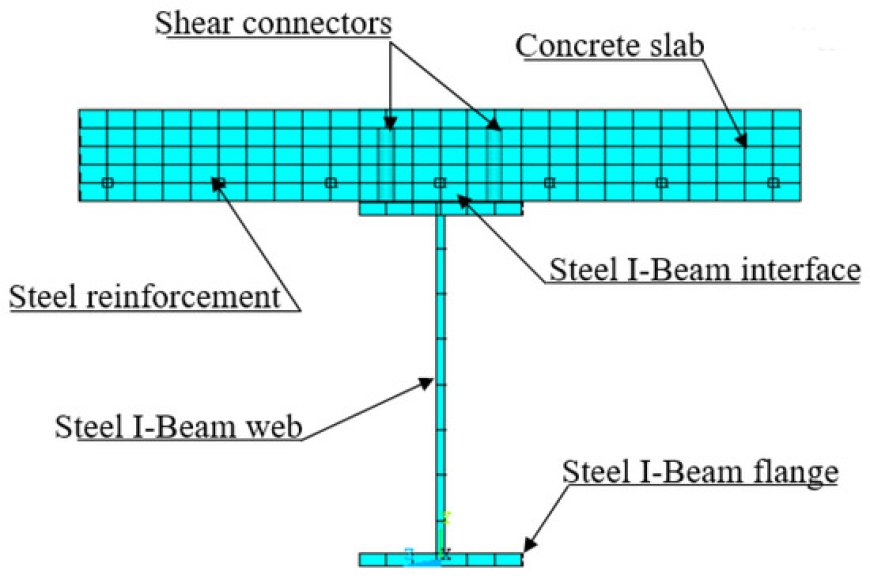
Strengthening of composite beams is highly needed to upgrade the capacities of existing beams. The strengthening methods can be classified as active or passive techniques. Therefore, the main purpose of this study is to provide detailed FE simulations for strengthened and unstrengthened steel–concrete composite beams at the sagging and hogging moment regions with and without profiled steel sheeting. The developed models were verified against experimental results from the literature. The verified models were used to present comparisons between the effect of using external post-tensioning and CFRP laminates as strengthening techniques. Applying external post-tensioning at the sagging moment regions is more effective because of the exhibited larger eccentricity. In the form of an initial camber and compressive stresses in the bottom flange prior to loading, this reasonable eccentricity induces reverse loading on the reinforced beams, reducing the net tensile stress induced during loading. Using CFRP laminates on the concrete slab for continuous composite beams is more effective in enhancing the beam capacity in comparison with using the external post-tension. However, reductions in the beam ductility were obtained.
CivilEng, Vol. 4, Pages 483-505: Numerical Modeling and Analysis of Strengthened Steel–Concrete Composite Beams in Sagging and Hogging Moment Regions
CivilEng doi: 10.3390/civileng4020028
Authors: Ayman El-Zohairy Suzan Mustafa Hesham Shaaban Hani Salim Abbas A. Allawi
Strengthening of composite beams is highly needed to upgrade the capacities of existing beams. The strengthening methods can be classified as active or passive techniques. Therefore, the main purpose of this study is to provide detailed FE simulations for strengthened and unstrengthened steel–concrete composite beams at the sagging and hogging moment regions with and without profiled steel sheeting. The developed models were verified against experimental results from the literature. The verified models were used to present comparisons between the effect of using external post-tensioning and CFRP laminates as strengthening techniques. Applying external post-tensioning at the sagging moment regions is more effective because of the exhibited larger eccentricity. In the form of an initial camber and compressive stresses in the bottom flange prior to loading, this reasonable eccentricity induces reverse loading on the reinforced beams, reducing the net tensile stress induced during loading. Using CFRP laminates on the concrete slab for continuous composite beams is more effective in enhancing the beam capacity in comparison with using the external post-tension. However, reductions in the beam ductility were obtained.
What's Your Reaction?