CivilEng, Vol. 4, Pages 506-521: Numerical and Code-Based Investigation on the Impact of Corrosion on the Ultimate Compressive Strength of Steel Angle Members Using Thickness Reduction Method
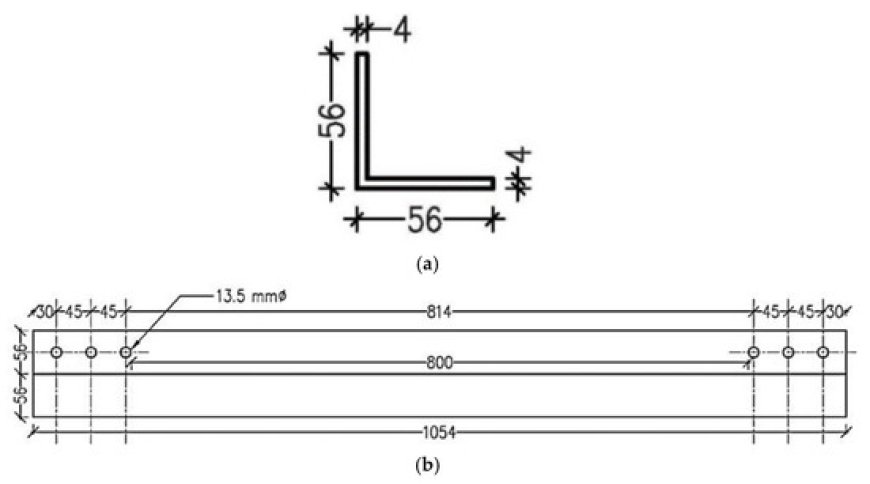
Damage assessment of corroded steel members due to severe exposure conditions, has been a vital component for determining the strengthening requirements of existing deteriorated structures, to overcome possible devastating failures. This article mainly focuses on steel angle members, which are mostly used as axially loaded members in different types of applications. In this study, the strategy of thickness reduction at corroded locations was demonstrated as a simple, convenient, and accurate method to represent the corrosion-equivalent properties of steel angles under axial compression. Further, the viability of the thickness reduction approach was evaluated in code-based and numerical approaches. Four standards, BS 5950-1:2000, BS EN 1993-1-1:2005, ASCE 10-15 and ANSI/AISC 360-16 were investigated to identify their applicability to obtain the residual compression capacities of corroded members. The capacity estimations of codes were compared with experimental data to demonstrate that the estimations of codes are not accurate when the level of corrosion is high. Finally, 39 corroded steel angle members of 10 different corrosion patterns were numerically modeled and analyzed to demonstrate the impact of different corrosion patterns on the compression capacity.
CivilEng, Vol. 4, Pages 506-521: Numerical and Code-Based Investigation on the Impact of Corrosion on the Ultimate Compressive Strength of Steel Angle Members Using Thickness Reduction Method
CivilEng doi: 10.3390/civileng4020029
Authors: Chamath Ravindu Senevirathna Chaminda S. Bandara Sudath C. Siriwardane
Damage assessment of corroded steel members due to severe exposure conditions, has been a vital component for determining the strengthening requirements of existing deteriorated structures, to overcome possible devastating failures. This article mainly focuses on steel angle members, which are mostly used as axially loaded members in different types of applications. In this study, the strategy of thickness reduction at corroded locations was demonstrated as a simple, convenient, and accurate method to represent the corrosion-equivalent properties of steel angles under axial compression. Further, the viability of the thickness reduction approach was evaluated in code-based and numerical approaches. Four standards, BS 5950-1:2000, BS EN 1993-1-1:2005, ASCE 10-15 and ANSI/AISC 360-16 were investigated to identify their applicability to obtain the residual compression capacities of corroded members. The capacity estimations of codes were compared with experimental data to demonstrate that the estimations of codes are not accurate when the level of corrosion is high. Finally, 39 corroded steel angle members of 10 different corrosion patterns were numerically modeled and analyzed to demonstrate the impact of different corrosion patterns on the compression capacity.
What's Your Reaction?