CivilEng, Vol. 4, Pages 311-332: Site-Specific Response Spectra and Accelerograms on Bedrock and Soil Surface
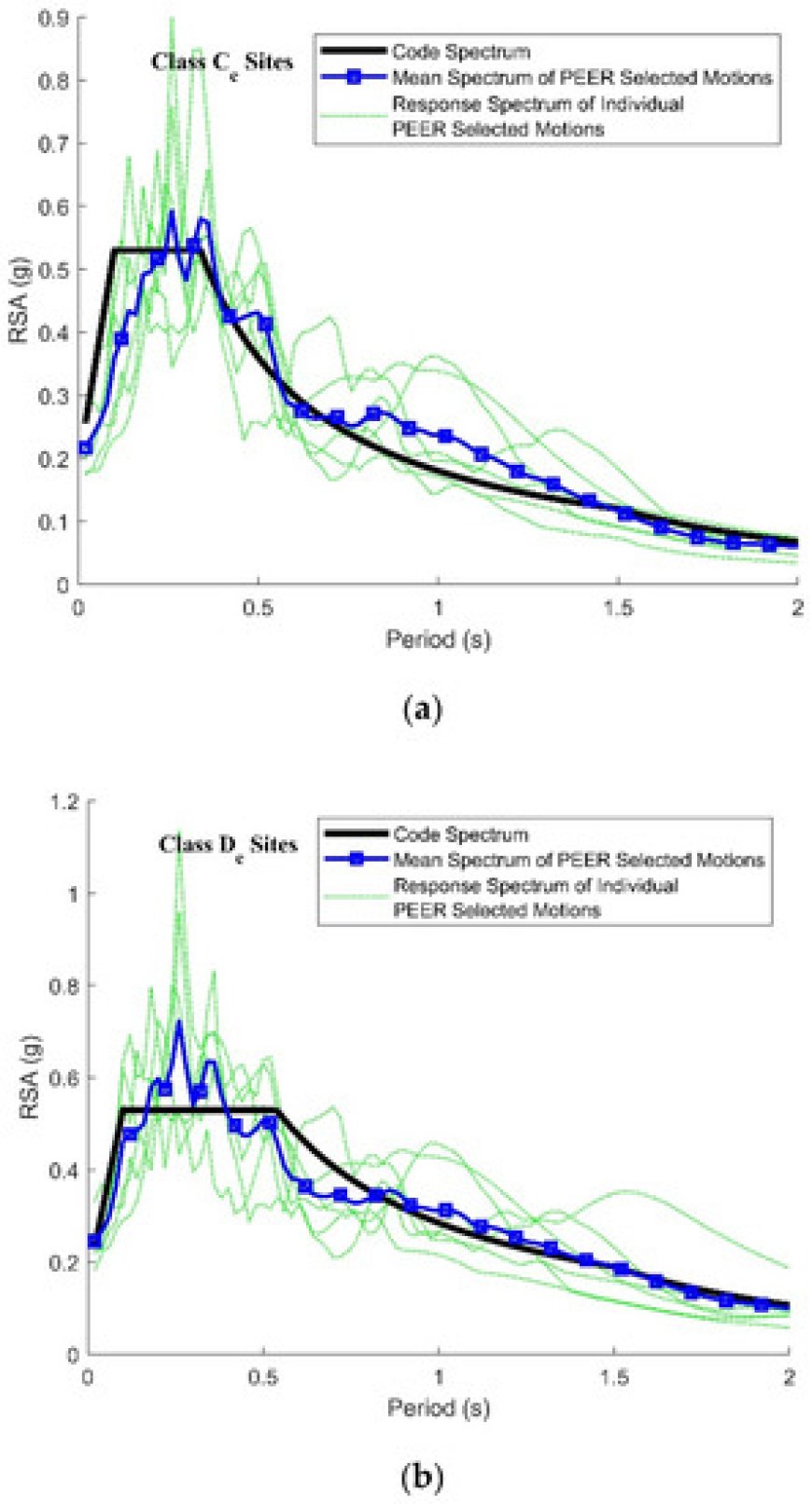
This paper is aimed at serving the needs of structural engineering researchers who are seeking accelerograms that realistically represent the time histories of earthquake ground in support of their own investigations. Every record is identified with a specific earthquake scenario defined by the magnitude–distance combination and site conditions; the intensity of the presented records is consistent with ultimate limit state design requirements for important structures in an intraplate region. Presented in this article are accelerograms that were generated on the soil surface of two example class Ce sites and two example class De sites based on site response analyses of the respective soil column models utilizing bedrock excitations as derived from the conditional mean spectrum (CMS) methodology. The CMS that were developed on rock sites were based on matching with the code spectrum model stipulated by the Australian standard for seismic actions for class Be sites at reference periods of 0.2, 0.5, 1 and 2 s for return periods ranging from 500 to 2500 years. The reference to Australian regulatory documents does not preclude the adoption of the presented materials for engineering applications outside Australia. To reduce modeling uncertainties, the simulation of the soil surface ground motion is specific to the site of interest and is based on information provided by the borelogs. The site-specific simulation of the strong motion is separate to the CMS-based accelerogram selection–scaling for obtaining the bedrock accelerograms (utilizing strong motion data provided by the PEER). The decoupling of the two processes is a departure from the use of the code site response spectrum models and has the merit of reducing modeling uncertainties and achieving more realistic representation of the seismic actions.
CivilEng, Vol. 4, Pages 311-332: Site-Specific Response Spectra and Accelerograms on Bedrock and Soil Surface
CivilEng doi: 10.3390/civileng4010018
Authors: Yiwei Hu Prashidha Khatiwada Hing-Ho Tsang Scott Menegon
This paper is aimed at serving the needs of structural engineering researchers who are seeking accelerograms that realistically represent the time histories of earthquake ground in support of their own investigations. Every record is identified with a specific earthquake scenario defined by the magnitude–distance combination and site conditions; the intensity of the presented records is consistent with ultimate limit state design requirements for important structures in an intraplate region. Presented in this article are accelerograms that were generated on the soil surface of two example class Ce sites and two example class De sites based on site response analyses of the respective soil column models utilizing bedrock excitations as derived from the conditional mean spectrum (CMS) methodology. The CMS that were developed on rock sites were based on matching with the code spectrum model stipulated by the Australian standard for seismic actions for class Be sites at reference periods of 0.2, 0.5, 1 and 2 s for return periods ranging from 500 to 2500 years. The reference to Australian regulatory documents does not preclude the adoption of the presented materials for engineering applications outside Australia. To reduce modeling uncertainties, the simulation of the soil surface ground motion is specific to the site of interest and is based on information provided by the borelogs. The site-specific simulation of the strong motion is separate to the CMS-based accelerogram selection–scaling for obtaining the bedrock accelerograms (utilizing strong motion data provided by the PEER). The decoupling of the two processes is a departure from the use of the code site response spectrum models and has the merit of reducing modeling uncertainties and achieving more realistic representation of the seismic actions.
What's Your Reaction?