CivilEng, Vol. 4, Pages 345-358: Port-of-Entry Simulation Model for Potential Wait Time Reduction and Air Quality Improvement: A Case Study at the Gateway International Bridge in Brownsville, Texas, USA
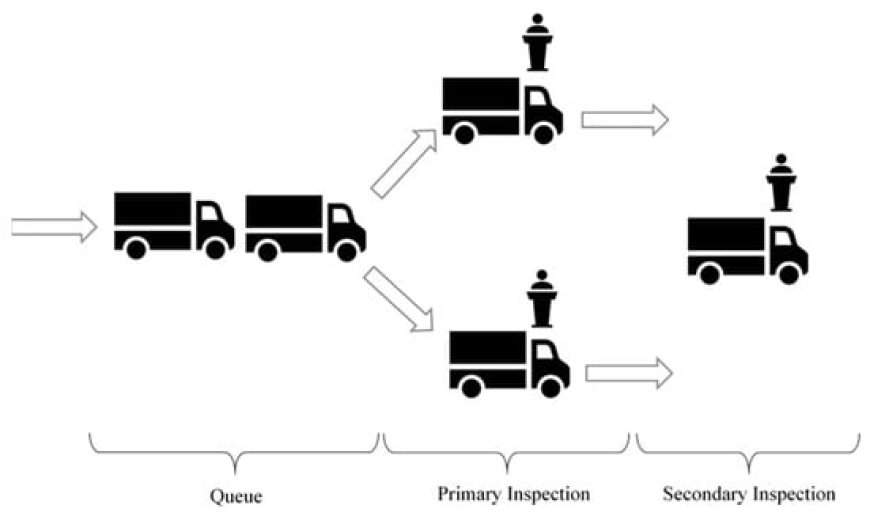
The mathematical study known as queueing theory has recently become a major point of interest for many government agencies and private companies for increasing efficiency. One such application is vehicle queueing at an international port-of-entry (POE). When queueing, fumes from idling vehicles negatively affect the overall health and well-being of the community, especially the U.S. Customs and Border Protection (CBP) agents that work at the POEs. As such, there is a need to analyze and optimize the border crossing queuing operations to minimize wait times and number of vehicles in the queue and, thus, reduce the vehicle emissions. For this research, the U.S.–Mexico POE located at The Gateway International Bridge in Brownsville, Texas, is used as a case study. Due to data privacy concerns, the hourly wait times for vehicles arriving at the border had to be extracted manually each day using a live wait time tracker online. The data extraction was performed for the month of March 2022. Using these wait times, a queueing simulation software, SIMIO, was used to develop an interactive simulation model and calibrate the service rates. The output from the SIMIO model was then used to develop an artificial neural network (ANN) to predict hourly particulate matter content with an R2 of 0.402. From the ANN, a predictive equation has been developed, which may be used by CBP to make operational decisions and improve the overall efficiency of this POE. Thus, lowering the average wait times and the emissions from idling vehicles in the queue.
CivilEng, Vol. 4, Pages 345-358: Port-of-Entry Simulation Model for Potential Wait Time Reduction and Air Quality Improvement: A Case Study at the Gateway International Bridge in Brownsville, Texas, USA
CivilEng doi: 10.3390/civileng4010020
Authors: Benjamin Stewart Hiram Moya Amit U. Raysoni Esmeralda Mendez Matthew Vechione
The mathematical study known as queueing theory has recently become a major point of interest for many government agencies and private companies for increasing efficiency. One such application is vehicle queueing at an international port-of-entry (POE). When queueing, fumes from idling vehicles negatively affect the overall health and well-being of the community, especially the U.S. Customs and Border Protection (CBP) agents that work at the POEs. As such, there is a need to analyze and optimize the border crossing queuing operations to minimize wait times and number of vehicles in the queue and, thus, reduce the vehicle emissions. For this research, the U.S.–Mexico POE located at The Gateway International Bridge in Brownsville, Texas, is used as a case study. Due to data privacy concerns, the hourly wait times for vehicles arriving at the border had to be extracted manually each day using a live wait time tracker online. The data extraction was performed for the month of March 2022. Using these wait times, a queueing simulation software, SIMIO, was used to develop an interactive simulation model and calibrate the service rates. The output from the SIMIO model was then used to develop an artificial neural network (ANN) to predict hourly particulate matter content with an R2 of 0.402. From the ANN, a predictive equation has been developed, which may be used by CBP to make operational decisions and improve the overall efficiency of this POE. Thus, lowering the average wait times and the emissions from idling vehicles in the queue.
What's Your Reaction?