CivilEng, Vol. 4, Pages 1243-1262: Developing a Sprayed-Glass Fiber-Reinforced Polymer Retrofitting System for Decommissioned Wooden Utility Poles
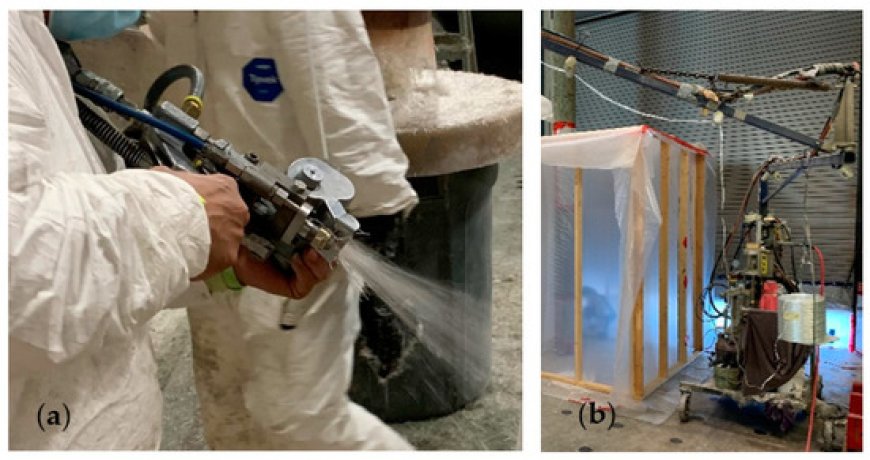
Wooden utility poles are vulnerable to degradation and decay, which requires maintenance or replacement. The strengthening and retrofitting techniques for wooden poles are either prone to corrosion or encountering installation difficulties. However, the use of sprayed fiber-reinforced polymer (FRP) composites seems to be a viable solution as it has proven its efficiency and applicability for reinforced concrete members and connections. This study includes a comprehensive experimental program where the mechanical properties of the sprayed-glass FRP (GFRP) composite was evaluated in terms of tensile, compressive and shear strength, in addition to its bond strength to wood and confinement efficiency. Afterwards, the results of the material testing phase were implemented on full-scale old utility poles to evaluate their structural performance with varying composite thicknesses and sprayed zone lengths. The behavior of the retrofitted poles reflected remarkable effectiveness for the sprayed-GFRP composite and highlighted the need for a design model for the optimum length for the sprayed zone. Two simplified analytical models were introduced which predicted the failure loads and locations for the tested poles and estimated the required length for the retrofitted zone, which all agreed well with the experimental results of the tested poles.
CivilEng, Vol. 4, Pages 1243-1262: Developing a Sprayed-Glass Fiber-Reinforced Polymer Retrofitting System for Decommissioned Wooden Utility Poles
CivilEng doi: 10.3390/civileng4040069
Authors: Amr E. Abdallah Shukai Chen Ehab F. El-Salakawy
Wooden utility poles are vulnerable to degradation and decay, which requires maintenance or replacement. The strengthening and retrofitting techniques for wooden poles are either prone to corrosion or encountering installation difficulties. However, the use of sprayed fiber-reinforced polymer (FRP) composites seems to be a viable solution as it has proven its efficiency and applicability for reinforced concrete members and connections. This study includes a comprehensive experimental program where the mechanical properties of the sprayed-glass FRP (GFRP) composite was evaluated in terms of tensile, compressive and shear strength, in addition to its bond strength to wood and confinement efficiency. Afterwards, the results of the material testing phase were implemented on full-scale old utility poles to evaluate their structural performance with varying composite thicknesses and sprayed zone lengths. The behavior of the retrofitted poles reflected remarkable effectiveness for the sprayed-GFRP composite and highlighted the need for a design model for the optimum length for the sprayed zone. Two simplified analytical models were introduced which predicted the failure loads and locations for the tested poles and estimated the required length for the retrofitted zone, which all agreed well with the experimental results of the tested poles.
What's Your Reaction?